


Cinnamon Synonyms Practice

Ben’s Bonus Books
Reading Compass: TOEFL Intensives: Level 4 Vol. 4
Reading Compass: TOEFL Intensives: Level 5 Vol. 1
Reading Compass: TOEFL Intensives: Level 5 Vol. 2
Reading Compass: TOEFL Intensives: Level 5 Vol. 3
Reading Compass: TOEFL Intensives: Level 5 Vol. 4
Grammar
Check Yourself
Check Yourself Book 1 is a comprehensive language arts course designed to help students become stronger writers, editors, readers, and communicators. Rather than focusing only on grammar rules, thi…
Check Yourself
Check Yourself Book 1
Writing, Grammar, and Editing for Independent Learners
Check Yourself Book 1 is a comprehensive language arts course designed to help students become stronger writers, editors, readers, and communicators. Rather than focusing only on grammar rules, this course teaches students how to build complete sentences, answer questions effectively, compare ideas, understand parts of speech, recognize common mistakes, and develop the habit of reviewing and improving their own writing.
Through a combination of grammar instruction, vocabulary development, spelling practice, reading comprehension, editing exercises, and guided writing activities, students learn how to communicate more clearly and confidently. Each unit encourages students to think critically about their writing and develop the self-correction skills necessary for long-term academic success.
What Makes This Course Unique?
Writing Comes First
Many grammar books focus on memorizing rules. Check Yourself focuses on applying those rules through writing.
Students learn how to:
Answer in complete sentences
- Add opinions and explanations
- Make predictions and educated guesses
- Expand simple answers into detailed responses
- Support ideas with reasons and examples
Every lesson encourages students to actively use language rather than simply identify grammar patterns.
Learn to Edit Like a Real Writer
One of the core goals of the course is helping students recognize and fix their own mistakes.
Students practice:
Capitalization
- Subject-verb agreement
- Punctuation
- Homophones
- Common spelling errors
- Sentence structure
By learning how to identify errors independently, students develop the habits of effective writers and editors.
A Complete Language Arts Approach
The course combines multiple language skills into a single program.
Students build:
Grammar skills
- Writing skills
- Reading comprehension
- Vocabulary development
- Spelling accuracy
- Critical thinking
- Editing skills
This integrated approach creates stronger overall language proficiency.
Meaningful Reading and Discussion
Throughout the course, students encounter original stories, thought-provoking questions, and open-ended writing prompts that encourage creativity and reflection.
Students learn to:
Support opinions
- Explain reasoning
- Make predictions
- Analyze stories
- Think beyond simple right-or-wrong answers
These activities help prepare students for higher-level academic writing and discussion.
Course Breakdown
Unit 1: Sentences
Students learn:
Capitalization
- Proper nouns
- Honorifics
- Writing complete sentence answers
- Adding opinions
- Making guesses
- Making predictions
Focus:
Building strong sentence-writing habits.
Unit 2: Comparative and Superlative Adjectives
Students learn:
Similarities and differences
- Comparatives
- Superlatives
- Better, best, worse, worst
- Comparisons using as…as
Focus:
Comparing ideas clearly and accurately.
Unit 3: Parts of Speech
Students learn:
Nouns
- Articles
- Adjectives
- Verbs
- Infinitives
- Gerunds
- Verb tenses
- Adverbs
Focus:
Understanding how words work together to build sentences.
Unit 4: Editing
Students learn:
Subject-verb agreement
- Common grammar mistakes
- Homophones
- Punctuation
- Run-on sentences
- Apostrophes
Focus:
Developing self-editing and proofreading skills.
Unit 5: Writing Like a Pro
Students learn:
Context clues
- Quotations
- Cause and effect
- Would vs. could
- Did vs. didn’t
- Even if vs. even though
Focus:
Writing with greater clarity, precision, and confidence.
Educational Purpose
The primary goal of Check Yourself Book 1 is to help students become independent learners who can recognize mistakes, improve their writing, and communicate more effectively.
Students learn how to:
Write complete and detailed responses
- Use grammar accurately
- Build stronger vocabulary
- Improve spelling
- Understand reading passages
- Edit their own work
- Develop critical thinking skills
By the end of the course, students will have a stronger foundation in grammar and writing while developing the confidence to evaluate and improve their own work.
Ideal For
- Upper elementary ESL/EFL learners
- Native English learners needing writing support
- Homeschool language arts programs
- Supplemental grammar and writing instruction
- Students preparing for academic writing
- Learners who need stronger editing and proofreading skills
Check Yourself helps students move beyond simply learning English rules and teaches them how to think like writers, editors, and effective communicators.
Writing
Writer’s Workshop
Writer's Workshop is a step-by-step essay writing course designed to guide students from writing individual sentences to producing complete, well-organized essays. Instead of simply telling student…
Writer’s Workshop
Writer’s Workshop: A Beginner’s Guide to Essay Writing
Learn to Think, Organize, and Write Like a Real Author
Writer’s Workshop is a step-by-step essay writing course designed to guide students from writing individual sentences to producing complete, well-organized essays. Instead of simply telling students what an essay should look like, the course breaks the writing process into manageable parts and teaches each skill individually before bringing everything together into a finished piece of writing.
Students learn how to identify key words in essay prompts, create engaging hooks, write informative backgrounds, develop strong thesis statements, organize body paragraphs, support ideas with explanations, and craft effective conclusions. Through guided instruction, examples, checklists, practice exercises, and full essay construction, students develop both the confidence and structure necessary to become successful writers.
Unlike many writing programs that ask students to “just write,” Writer’s Workshop teaches the thinking process behind writing. Students learn how to analyze prompts, brainstorm ideas, organize information logically, defend opinions, support arguments with evidence, and communicate ideas clearly and persuasively.
What Makes This Course Unique?
Writing Broken Into Simple, Achievable Steps
The course teaches essay writing one skill at a time:
Finding key words
- Writing hooks
- Building background information
- Creating thesis statements
- Writing topic sentences
- Expanding ideas with explanations
- Constructing conclusions
- Combining everything into complete essays
This scaffolded approach makes essay writing approachable even for reluctant or inexperienced writers.
Focus on Thinking Before Writing
Students learn that strong writing begins with strong thinking.
They practice:
Identifying main topics
- Asking questions
- Brainstorming ideas
- Considering multiple viewpoints
- Supporting opinions with reasons
- Developing arguments
These skills strengthen not only writing, but also reading comprehension and critical thinking.
Structured Academic Writing
Students learn the complete structure of a five-paragraph essay.
They master:
Introduction paragraphs
- Thesis statements
- Body paragraphs
- Topic sentences
- Supporting details
- Conclusions
This framework prepares students for upper elementary, middle school, and future academic writing assignments.
Built-In Writing Checklists
Throughout the course, students use self-check systems that teach them to evaluate and improve their own work.
Students learn how to ask:
Did I answer the question?
- Did I use key words?
- Did I support my opinion?
- Is my thesis specific?
- Did I organize my ideas clearly?
These habits help students become independent writers.
Opinion Writing and Argument Development
As students progress, they learn how to:
Take a position
- Consider opposing viewpoints
- Strengthen arguments
- Support claims with evidence
- Write more persuasive essays
The course introduces foundational academic argumentation in a student-friendly way.
Course Breakdown
Part 1: Building the Introduction
Students learn:
Key Words
- Hooks
- Background Information
- Thesis Statements
- Specific Theses
- Stronger Theses
Focus:
Learning how to begin an essay with a clear purpose and direction.
Part 2: Building Body Paragraphs
Students learn:
Topic Sentences
- Explanations
- Supporting Details
- Examples
- Logical Organization
Focus:
Learning how to support ideas and develop strong paragraphs.
Part 3: Writing Conclusions
Students learn:
Rephrased Thesis Statements
- Summaries
- Final Thoughts
- Closers
Focus:
Learning how to end essays effectively and leave a lasting impression on readers.
Part 4: Full Essay Construction
Students learn:
Essay Planning
- Essay Organization
- Drafting
- Revision
- Complete Essay Writing
Focus:
Combining all previously learned skills into polished academic essays.
Educational Purpose
The primary goal of Writer’s Workshop is to teach students the complete essay-writing process from start to finish.
Students learn how to:
Understand essay prompts
- Generate ideas
- Organize information
- Write introductions
- Develop arguments
- Support opinions with evidence
- Write body paragraphs
- Create conclusions
- Edit and improve their work
By the end of the course, students will have a clear understanding of how essays are built and the confidence to write independently across a variety of academic and creative topics.
Ideal For
- Grades 3–8 students
- ESL/EFL learners
- Homeschool language arts programs
- Academic writing preparation
- Opinion writing instruction
- Students preparing for standardized writing assessments
- Learners who need a clear, structured approach to essay writing
Writer’s Workshop transforms essay writing from an intimidating task into a series of simple, achievable steps that help students become confident, organized, and effective writers.
Vocabulary
Cinnabunnies Book 1 Vol. 1: The Garden of Synonyms
Welcome to the sweet and magical world of the Cinnabunnies, where learning new words is as fun as exploring candy castles, soda pop seas, and chocolate kingdoms. In this vocabulary-building course,…
Cinnabunnies Book 1 Vol. 1: The Garden of Synonyms
Cinnabunnies Volume 1: The Cinnamon Book of Synonyms
Building Bigger Vocabulary Through Stories, Friendship, and Adventure
Welcome to the sweet and magical world of the Cinnabunnies, where learning new words is as fun as exploring candy castles, soda pop seas, and chocolate kingdoms. In this vocabulary-building course, students follow Puff, Zoey, Butter, Hunny, Jelly, Cuppy, and their friends as they learn powerful new synonyms through stories, games, spelling activities, reading comprehension, and creative writing.
Throughout the course, students expand their vocabulary by learning multiple ways to express common ideas and emotions. Instead of simply learning words like big, happy, or smart, students discover richer vocabulary such as enormous, joyful, clever, and fearless. By encountering these words repeatedly in stories, activities, and writing exercises, students build stronger reading comprehension and more expressive writing skills.
What Makes This Course Unique?
Vocabulary Through Storytelling
Every lesson takes place inside the whimsical world of the Cinnabunnies.
Students:
Meet memorable characters
- Explore magical locations
- Read short stories featuring target vocabulary
- Learn new words through meaningful contexts
- Apply vocabulary immediately through writing activities
Instead of memorizing isolated word lists, students learn vocabulary through characters and adventures they can connect with.
Learning Synonyms Naturally
Each lesson introduces a pair of opposite concepts and explores multiple synonyms for each.
For example:
Big → huge, enormous, gigantic
- Happy → joyful, cheerful, content
- Brave → fearless, daring, confident
- Smart → clever, wise, bright
Students learn that there are many ways to express similar ideas, helping them become more flexible and sophisticated communicators.
Multiple Opportunities for Practice
Every lesson includes:
Vocabulary introduction
- Fill-in-the-blank activities
- Story-based reading practice
- Reading comprehension questions
- Spelling reinforcement
- Creative writing exercises
This layered approach helps students move vocabulary from recognition to active use.
Writing From the Beginning
Students are encouraged to use newly learned words in their own writing.
Creative writing activities help students:
Practice sentence building
- Strengthen vocabulary retention
- Develop imagination
- Build confidence as writers
By regularly using new words in original writing, students gain ownership of their expanding vocabulary.
Built-In Review and Reinforcement
Each unit concludes with cumulative review activities that revisit previously learned words through:
Vocabulary substitution
- Multiple-choice questions
- Spelling practice
- Guided writing
This review structure helps ensure long-term retention rather than short-term memorization.
Lesson Breakdown
Unit 1: Basic Adjectives
Students learn synonyms for:
Lesson 1: Big vs. Small
Big:
Huge
- Large
- Giant
- Enormous
- Gigantic
Small:
Tiny
- Little
- Short
- Teeny
- Puny
Focus Skills:
Descriptive vocabulary
- Comparing size
- Synonym recognition
- Story-based comprehension
- Lesson 2: Good vs. Bad
Good:
Great
- Super
- Awesome
- Amazing
- Wonderful
Bad:
Awful
- Terrible
- Horrible
- Nasty
- Dreadful
Focus Skills:
Opinion words
- Positive and negative descriptions
- Expressive language
- Lesson 3: Easy vs. Hard
Easy:
Simple
- Breezy
- Smooth
- No Sweat
- No Problem
Hard:
Difficult
- Tough
- Tricky
- Complex
- Puzzling
Focus Skills:
Academic vocabulary
- Problem-solving language
- Describing challenges
- Unit 2: Feelings
Students learn vocabulary related to emotions and social interactions.
Lesson 1: Happy vs. Sad
Happy:
Joyful
- Excited
- Cheerful
- Jolly
- Content
Sad:
Unhappy
- Blue
- Gloomy
- Tearful
- Down
Focus Skills:
Emotional vocabulary
- Character feelings
- Reading emotional context
- Lesson 2: Excited vs. Mad
Excited:
Thrilled
- Eager
- Pumped
- Giddy
- Overjoyed
Mad:
Upset
- Angry
- Cross
- Annoyed
- Frustrated
Focus Skills:
Emotional expression
- Understanding reactions
- Expanding feeling words
- Lesson 3: Nice vs. Mean
Nice:
Kind
- Friendly
- Gentle
- Polite
- Caring
Mean:
Unkind
- Hurtful
- Unfriendly
- Rude
- Grumpy
Focus Skills:
Social-emotional learning
- Character traits
- Positive communication
- Unit 3: Personality
Students learn vocabulary used to describe people and behaviors.
Lesson 1: Brave vs. Shy
Brave:
Bold
- Fearless
- Strong
- Daring
- Confident
Shy:
Timid
- Nervous
- Quiet
- Bashful
- Meek
Focus Skills:
Personality vocabulary
- Character analysis
- Self-expression
- Lesson 2: Smart vs. Not Smart
Smart:
Clever
- Bright
- Sharp
- Wise
- Brainy
Not Smart:
Dull
- Dense
- Silly
- Slow
- Goofy
Focus Skills:
Describing thinking skills
- Character traits
- Vocabulary precision
- Lesson 3: Fun vs. Boring
Fun:
Joyful
- Playful
- Amusing
- Exciting
- A Blast
Boring:
Dull
- Ho Hum
- Uninteresting
- No Fun
- Unexciting
Focus Skills:
Describing experiences
- Opinion vocabulary
- Personal expression
- Educational Progression
- Stage 1
Basic Descriptive Vocabulary
⬇
Stage 2
Feelings and Emotions
⬇
Stage 3
Social and Character Traits
⬇
Stage 4
Personality and Self-Expression
⬇
Stage 5
Creative Vocabulary Usage
⬇
Stage 6
Independent Writing with Synonyms
Educational Purpose
The primary purpose of Cinnabunnies Volume 1 is to help students expand their expressive vocabulary through repeated exposure, contextual learning, and creative application.
Students learn how to:
Recognize and use synonyms
- Improve reading comprehension
- Strengthen writing skills
- Develop descriptive language
- Understand emotional vocabulary
- Express ideas with greater precision
- Build confidence as readers and writers
By the end of the course, students will have learned dozens of high-frequency vocabulary words and developed the ability to use richer language in both speaking and writing.
Ideal For
- Grades 1–4 ESL/EFL learners
- Emerging readers
- Vocabulary development programs
- Homeschool language arts instruction
- Students preparing for stronger reading and writing performance
- Learners who enjoy stories, characters, and imaginative worlds
Cinnabunnies Volume 1 transforms vocabulary study into an engaging adventure where every new word unlocks a bigger, brighter, and more expressive way to communicate.
Vocabulary
Cinnabunnies Book 1 Vol. 2: The Garden of Synonyms
Welcome to the sweet and magical world of the Cinnabunnies, where learning new words is as fun as exploring candy castles, soda pop seas, and chocolate kingdoms. In this vocabulary-building course,…
Cinnabunnies Book 1 Vol. 2: The Garden of Synonyms
Cinnabunnies Volume 1: The Cinnamon Book of Synonyms
Building Bigger Vocabulary Through Stories, Friendship, and Adventure
Welcome to the sweet and magical world of the Cinnabunnies, where learning new words is as fun as exploring candy castles, soda pop seas, and chocolate kingdoms. In this vocabulary-building course, students follow Puff, Zoey, Butter, Hunny, Jelly, Cuppy, and their friends as they learn powerful new synonyms through stories, games, spelling activities, reading comprehension, and creative writing.
Throughout the course, students expand their vocabulary by learning multiple ways to express common ideas and emotions. Instead of simply learning words like big, happy, or smart, students discover richer vocabulary such as enormous, joyful, clever, and fearless. By encountering these words repeatedly in stories, activities, and writing exercises, students build stronger reading comprehension and more expressive writing skills.
What Makes This Course Unique?
Vocabulary Through Storytelling
Every lesson takes place inside the whimsical world of the Cinnabunnies.
Students:
Meet memorable characters
- Explore magical locations
- Read short stories featuring target vocabulary
- Learn new words through meaningful contexts
- Apply vocabulary immediately through writing activities
Instead of memorizing isolated word lists, students learn vocabulary through characters and adventures they can connect with.
Learning Synonyms Naturally
Each lesson introduces a pair of opposite concepts and explores multiple synonyms for each.
For example:
Big → huge, enormous, gigantic
- Happy → joyful, cheerful, content
- Brave → fearless, daring, confident
- Smart → clever, wise, bright
Students learn that there are many ways to express similar ideas, helping them become more flexible and sophisticated communicators.
Multiple Opportunities for Practice
Every lesson includes:
Vocabulary introduction
- Fill-in-the-blank activities
- Story-based reading practice
- Reading comprehension questions
- Spelling reinforcement
- Creative writing exercises
This layered approach helps students move vocabulary from recognition to active use.
Writing From the Beginning
Students are encouraged to use newly learned words in their own writing.
Creative writing activities help students:
Practice sentence building
- Strengthen vocabulary retention
- Develop imagination
- Build confidence as writers
By regularly using new words in original writing, students gain ownership of their expanding vocabulary.
Built-In Review and Reinforcement
Each unit concludes with cumulative review activities that revisit previously learned words through:
Vocabulary substitution
- Multiple-choice questions
- Spelling practice
- Guided writing
This review structure helps ensure long-term retention rather than short-term memorization.
Lesson Breakdown
Unit 1: Basic Adjectives
Students learn synonyms for:
Lesson 1: Big vs. Small
Big:
Huge
- Large
- Giant
- Enormous
- Gigantic
Small:
Tiny
- Little
- Short
- Teeny
- Puny
Focus Skills:
Descriptive vocabulary
- Comparing size
- Synonym recognition
- Story-based comprehension
- Lesson 2: Good vs. Bad
Good:
Great
- Super
- Awesome
- Amazing
- Wonderful
Bad:
Awful
- Terrible
- Horrible
- Nasty
- Dreadful
Focus Skills:
Opinion words
- Positive and negative descriptions
- Expressive language
- Lesson 3: Easy vs. Hard
Easy:
Simple
- Breezy
- Smooth
- No Sweat
- No Problem
Hard:
Difficult
- Tough
- Tricky
- Complex
- Puzzling
Focus Skills:
Academic vocabulary
- Problem-solving language
- Describing challenges
- Unit 2: Feelings
Students learn vocabulary related to emotions and social interactions.
Lesson 1: Happy vs. Sad
Happy:
Joyful
- Excited
- Cheerful
- Jolly
- Content
Sad:
Unhappy
- Blue
- Gloomy
- Tearful
- Down
Focus Skills:
Emotional vocabulary
- Character feelings
- Reading emotional context
- Lesson 2: Excited vs. Mad
Excited:
Thrilled
- Eager
- Pumped
- Giddy
- Overjoyed
Mad:
Upset
- Angry
- Cross
- Annoyed
- Frustrated
Focus Skills:
Emotional expression
- Understanding reactions
- Expanding feeling words
- Lesson 3: Nice vs. Mean
Nice:
Kind
- Friendly
- Gentle
- Polite
- Caring
Mean:
Unkind
- Hurtful
- Unfriendly
- Rude
- Grumpy
Focus Skills:
Social-emotional learning
- Character traits
- Positive communication
- Unit 3: Personality
Students learn vocabulary used to describe people and behaviors.
Lesson 1: Brave vs. Shy
Brave:
Bold
- Fearless
- Strong
- Daring
- Confident
Shy:
Timid
- Nervous
- Quiet
- Bashful
- Meek
Focus Skills:
Personality vocabulary
- Character analysis
- Self-expression
- Lesson 2: Smart vs. Not Smart
Smart:
Clever
- Bright
- Sharp
- Wise
- Brainy
Not Smart:
Dull
- Dense
- Silly
- Slow
- Goofy
Focus Skills:
Describing thinking skills
- Character traits
- Vocabulary precision
- Lesson 3: Fun vs. Boring
Fun:
Joyful
- Playful
- Amusing
- Exciting
- A Blast
Boring:
Dull
- Ho Hum
- Uninteresting
- No Fun
- Unexciting
Focus Skills:
Describing experiences
- Opinion vocabulary
- Personal expression
- Educational Progression
- Stage 1
Basic Descriptive Vocabulary
⬇
Stage 2
Feelings and Emotions
⬇
Stage 3
Social and Character Traits
⬇
Stage 4
Personality and Self-Expression
⬇
Stage 5
Creative Vocabulary Usage
⬇
Stage 6
Independent Writing with Synonyms
Educational Purpose
The primary purpose of Cinnabunnies Volume 1 is to help students expand their expressive vocabulary through repeated exposure, contextual learning, and creative application.
Students learn how to:
Recognize and use synonyms
- Improve reading comprehension
- Strengthen writing skills
- Develop descriptive language
- Understand emotional vocabulary
- Express ideas with greater precision
- Build confidence as readers and writers
By the end of the course, students will have learned dozens of high-frequency vocabulary words and developed the ability to use richer language in both speaking and writing.
Ideal For
- Grades 1–4 ESL/EFL learners
- Emerging readers
- Vocabulary development programs
- Homeschool language arts instruction
- Students preparing for stronger reading and writing performance
- Learners who enjoy stories, characters, and imaginative worlds
Cinnabunnies Volume 1 transforms vocabulary study into an engaging adventure where every new word unlocks a bigger, brighter, and more expressive way to communicate.
Vocabulary
Cinnabunnies Book 1 Vol. 3: The Garden of Synonyms
Welcome to the sweet and magical world of the Cinnabunnies, where learning new words is as fun as exploring candy castles, soda pop seas, and chocolate kingdoms. In this vocabulary-building course,…
Cinnabunnies Book 1 Vol. 3: The Garden of Synonyms
Cinnabunnies Volume 1: The Cinnamon Book of Synonyms
Building Bigger Vocabulary Through Stories, Friendship, and Adventure
Welcome to the sweet and magical world of the Cinnabunnies, where learning new words is as fun as exploring candy castles, soda pop seas, and chocolate kingdoms. In this vocabulary-building course, students follow Puff, Zoey, Butter, Hunny, Jelly, Cuppy, and their friends as they learn powerful new synonyms through stories, games, spelling activities, reading comprehension, and creative writing.
Throughout the course, students expand their vocabulary by learning multiple ways to express common ideas and emotions. Instead of simply learning words like big, happy, or smart, students discover richer vocabulary such as enormous, joyful, clever, and fearless. By encountering these words repeatedly in stories, activities, and writing exercises, students build stronger reading comprehension and more expressive writing skills.
What Makes This Course Unique?
Vocabulary Through Storytelling
Every lesson takes place inside the whimsical world of the Cinnabunnies.
Students:
Meet memorable characters
- Explore magical locations
- Read short stories featuring target vocabulary
- Learn new words through meaningful contexts
- Apply vocabulary immediately through writing activities
Instead of memorizing isolated word lists, students learn vocabulary through characters and adventures they can connect with.
Learning Synonyms Naturally
Each lesson introduces a pair of opposite concepts and explores multiple synonyms for each.
For example:
Big → huge, enormous, gigantic
- Happy → joyful, cheerful, content
- Brave → fearless, daring, confident
- Smart → clever, wise, bright
Students learn that there are many ways to express similar ideas, helping them become more flexible and sophisticated communicators.
Multiple Opportunities for Practice
Every lesson includes:
Vocabulary introduction
- Fill-in-the-blank activities
- Story-based reading practice
- Reading comprehension questions
- Spelling reinforcement
- Creative writing exercises
This layered approach helps students move vocabulary from recognition to active use.
Writing From the Beginning
Students are encouraged to use newly learned words in their own writing.
Creative writing activities help students:
Practice sentence building
- Strengthen vocabulary retention
- Develop imagination
- Build confidence as writers
By regularly using new words in original writing, students gain ownership of their expanding vocabulary.
Built-In Review and Reinforcement
Each unit concludes with cumulative review activities that revisit previously learned words through:
Vocabulary substitution
- Multiple-choice questions
- Spelling practice
- Guided writing
This review structure helps ensure long-term retention rather than short-term memorization.
Lesson Breakdown
Unit 1: Basic Adjectives
Students learn synonyms for:
Lesson 1: Big vs. Small
Big:
Huge
- Large
- Giant
- Enormous
- Gigantic
Small:
Tiny
- Little
- Short
- Teeny
- Puny
Focus Skills:
Descriptive vocabulary
- Comparing size
- Synonym recognition
- Story-based comprehension
- Lesson 2: Good vs. Bad
Good:
Great
- Super
- Awesome
- Amazing
- Wonderful
Bad:
Awful
- Terrible
- Horrible
- Nasty
- Dreadful
Focus Skills:
Opinion words
- Positive and negative descriptions
- Expressive language
- Lesson 3: Easy vs. Hard
Easy:
Simple
- Breezy
- Smooth
- No Sweat
- No Problem
Hard:
Difficult
- Tough
- Tricky
- Complex
- Puzzling
Focus Skills:
Academic vocabulary
- Problem-solving language
- Describing challenges
- Unit 2: Feelings
Students learn vocabulary related to emotions and social interactions.
Lesson 1: Happy vs. Sad
Happy:
Joyful
- Excited
- Cheerful
- Jolly
- Content
Sad:
Unhappy
- Blue
- Gloomy
- Tearful
- Down
Focus Skills:
Emotional vocabulary
- Character feelings
- Reading emotional context
- Lesson 2: Excited vs. Mad
Excited:
Thrilled
- Eager
- Pumped
- Giddy
- Overjoyed
Mad:
Upset
- Angry
- Cross
- Annoyed
- Frustrated
Focus Skills:
Emotional expression
- Understanding reactions
- Expanding feeling words
- Lesson 3: Nice vs. Mean
Nice:
Kind
- Friendly
- Gentle
- Polite
- Caring
Mean:
Unkind
- Hurtful
- Unfriendly
- Rude
- Grumpy
Focus Skills:
Social-emotional learning
- Character traits
- Positive communication
- Unit 3: Personality
Students learn vocabulary used to describe people and behaviors.
Lesson 1: Brave vs. Shy
Brave:
Bold
- Fearless
- Strong
- Daring
- Confident
Shy:
Timid
- Nervous
- Quiet
- Bashful
- Meek
Focus Skills:
Personality vocabulary
- Character analysis
- Self-expression
- Lesson 2: Smart vs. Not Smart
Smart:
Clever
- Bright
- Sharp
- Wise
- Brainy
Not Smart:
Dull
- Dense
- Silly
- Slow
- Goofy
Focus Skills:
Describing thinking skills
- Character traits
- Vocabulary precision
- Lesson 3: Fun vs. Boring
Fun:
Joyful
- Playful
- Amusing
- Exciting
- A Blast
Boring:
Dull
- Ho Hum
- Uninteresting
- No Fun
- Unexciting
Focus Skills:
Describing experiences
- Opinion vocabulary
- Personal expression
- Educational Progression
- Stage 1
Basic Descriptive Vocabulary
⬇
Stage 2
Feelings and Emotions
⬇
Stage 3
Social and Character Traits
⬇
Stage 4
Personality and Self-Expression
⬇
Stage 5
Creative Vocabulary Usage
⬇
Stage 6
Independent Writing with Synonyms
Educational Purpose
The primary purpose of Cinnabunnies Volume 1 is to help students expand their expressive vocabulary through repeated exposure, contextual learning, and creative application.
Students learn how to:
Recognize and use synonyms
- Improve reading comprehension
- Strengthen writing skills
- Develop descriptive language
- Understand emotional vocabulary
- Express ideas with greater precision
- Build confidence as readers and writers
By the end of the course, students will have learned dozens of high-frequency vocabulary words and developed the ability to use richer language in both speaking and writing.
Ideal For
- Grades 1–4 ESL/EFL learners
- Emerging readers
- Vocabulary development programs
- Homeschool language arts instruction
- Students preparing for stronger reading and writing performance
- Learners who enjoy stories, characters, and imaginative worlds
Cinnabunnies Volume 1 transforms vocabulary study into an engaging adventure where every new word unlocks a bigger, brighter, and more expressive way to communicate.
Vocabulary
Cinnabunnies Book 1 Vol. 4: The Garden of Synonyms
Welcome to the sweet and magical world of the Cinnabunnies, where learning new words is as fun as exploring candy castles, soda pop seas, and chocolate kingdoms. In this vocabulary-building course,…
Cinnabunnies Book 1 Vol. 4: The Garden of Synonyms
Cinnabunnies Volume 1: The Cinnamon Book of Synonyms
Building Bigger Vocabulary Through Stories, Friendship, and Adventure
Welcome to the sweet and magical world of the Cinnabunnies, where learning new words is as fun as exploring candy castles, soda pop seas, and chocolate kingdoms. In this vocabulary-building course, students follow Puff, Zoey, Butter, Hunny, Jelly, Cuppy, and their friends as they learn powerful new synonyms through stories, games, spelling activities, reading comprehension, and creative writing.
Throughout the course, students expand their vocabulary by learning multiple ways to express common ideas and emotions. Instead of simply learning words like big, happy, or smart, students discover richer vocabulary such as enormous, joyful, clever, and fearless. By encountering these words repeatedly in stories, activities, and writing exercises, students build stronger reading comprehension and more expressive writing skills.
What Makes This Course Unique?
Vocabulary Through Storytelling
Every lesson takes place inside the whimsical world of the Cinnabunnies.
Students:
Meet memorable characters
- Explore magical locations
- Read short stories featuring target vocabulary
- Learn new words through meaningful contexts
- Apply vocabulary immediately through writing activities
Instead of memorizing isolated word lists, students learn vocabulary through characters and adventures they can connect with.
Learning Synonyms Naturally
Each lesson introduces a pair of opposite concepts and explores multiple synonyms for each.
For example:
Big → huge, enormous, gigantic
- Happy → joyful, cheerful, content
- Brave → fearless, daring, confident
- Smart → clever, wise, bright
Students learn that there are many ways to express similar ideas, helping them become more flexible and sophisticated communicators.
Multiple Opportunities for Practice
Every lesson includes:
Vocabulary introduction
- Fill-in-the-blank activities
- Story-based reading practice
- Reading comprehension questions
- Spelling reinforcement
- Creative writing exercises
This layered approach helps students move vocabulary from recognition to active use.
Writing From the Beginning
Students are encouraged to use newly learned words in their own writing.
Creative writing activities help students:
Practice sentence building
- Strengthen vocabulary retention
- Develop imagination
- Build confidence as writers
By regularly using new words in original writing, students gain ownership of their expanding vocabulary.
Built-In Review and Reinforcement
Each unit concludes with cumulative review activities that revisit previously learned words through:
Vocabulary substitution
- Multiple-choice questions
- Spelling practice
- Guided writing
This review structure helps ensure long-term retention rather than short-term memorization.
Lesson Breakdown
Unit 1: Basic Adjectives
Students learn synonyms for:
Lesson 1: Big vs. Small
Big:
Huge
- Large
- Giant
- Enormous
- Gigantic
Small:
Tiny
- Little
- Short
- Teeny
- Puny
Focus Skills:
Descriptive vocabulary
- Comparing size
- Synonym recognition
- Story-based comprehension
- Lesson 2: Good vs. Bad
Good:
Great
- Super
- Awesome
- Amazing
- Wonderful
Bad:
Awful
- Terrible
- Horrible
- Nasty
- Dreadful
Focus Skills:
Opinion words
- Positive and negative descriptions
- Expressive language
- Lesson 3: Easy vs. Hard
Easy:
Simple
- Breezy
- Smooth
- No Sweat
- No Problem
Hard:
Difficult
- Tough
- Tricky
- Complex
- Puzzling
Focus Skills:
Academic vocabulary
- Problem-solving language
- Describing challenges
- Unit 2: Feelings
Students learn vocabulary related to emotions and social interactions.
Lesson 1: Happy vs. Sad
Happy:
Joyful
- Excited
- Cheerful
- Jolly
- Content
Sad:
Unhappy
- Blue
- Gloomy
- Tearful
- Down
Focus Skills:
Emotional vocabulary
- Character feelings
- Reading emotional context
- Lesson 2: Excited vs. Mad
Excited:
Thrilled
- Eager
- Pumped
- Giddy
- Overjoyed
Mad:
Upset
- Angry
- Cross
- Annoyed
- Frustrated
Focus Skills:
Emotional expression
- Understanding reactions
- Expanding feeling words
- Lesson 3: Nice vs. Mean
Nice:
Kind
- Friendly
- Gentle
- Polite
- Caring
Mean:
Unkind
- Hurtful
- Unfriendly
- Rude
- Grumpy
Focus Skills:
Social-emotional learning
- Character traits
- Positive communication
- Unit 3: Personality
Students learn vocabulary used to describe people and behaviors.
Lesson 1: Brave vs. Shy
Brave:
Bold
- Fearless
- Strong
- Daring
- Confident
Shy:
Timid
- Nervous
- Quiet
- Bashful
- Meek
Focus Skills:
Personality vocabulary
- Character analysis
- Self-expression
- Lesson 2: Smart vs. Not Smart
Smart:
Clever
- Bright
- Sharp
- Wise
- Brainy
Not Smart:
Dull
- Dense
- Silly
- Slow
- Goofy
Focus Skills:
Describing thinking skills
- Character traits
- Vocabulary precision
- Lesson 3: Fun vs. Boring
Fun:
Joyful
- Playful
- Amusing
- Exciting
- A Blast
Boring:
Dull
- Ho Hum
- Uninteresting
- No Fun
- Unexciting
Focus Skills:
Describing experiences
- Opinion vocabulary
- Personal expression
- Educational Progression
- Stage 1
Basic Descriptive Vocabulary
⬇
Stage 2
Feelings and Emotions
⬇
Stage 3
Social and Character Traits
⬇
Stage 4
Personality and Self-Expression
⬇
Stage 5
Creative Vocabulary Usage
⬇
Stage 6
Independent Writing with Synonyms
Educational Purpose
The primary purpose of Cinnabunnies Volume 1 is to help students expand their expressive vocabulary through repeated exposure, contextual learning, and creative application.
Students learn how to:
Recognize and use synonyms
- Improve reading comprehension
- Strengthen writing skills
- Develop descriptive language
- Understand emotional vocabulary
- Express ideas with greater precision
- Build confidence as readers and writers
By the end of the course, students will have learned dozens of high-frequency vocabulary words and developed the ability to use richer language in both speaking and writing.
Ideal For
- Grades 1–4 ESL/EFL learners
- Emerging readers
- Vocabulary development programs
- Homeschool language arts instruction
- Students preparing for stronger reading and writing performance
- Learners who enjoy stories, characters, and imaginative worlds
Cinnabunnies Volume 1 transforms vocabulary study into an engaging adventure where every new word unlocks a bigger, brighter, and more expressive way to communicate.
Reading
Deep Reading with Roald Dahl Vol. 1
A literature-based reading and critical thinking program inspired by the imaginative world of Roald Dahl
Deep Reading with Roald Dahl Vol. 1
Deep Reading with Roald Dahl Vol. 1
A literature-based reading and critical thinking program inspired by the imaginative world of Roald Dahl
Deep Reading with Roald Dahl Vol. 1 introduces young readers to some of Roald Dahl’s most entertaining and accessible stories, including Fantastic Mr. Fox, The Twits, and George’s Marvelous Medicine. More than a traditional novel study, this program combines literature, nonfiction reading, vocabulary development, literary analysis, creative writing, and critical thinking to help students become stronger, more thoughtful readers.
Students explore fascinating real-world topics connected to the novels, such as world foods, animal folklore, beauty and symmetry, insects as food, medicine and potions, and the science of aging. Along the way, they learn important literary concepts including character, conflict, heroes and villains, plot structure, author’s purpose, and descriptive writing.
Designed for upper elementary learners, each lesson encourages students to connect stories with the real world while building vocabulary, comprehension, writing skills, and analytical thinking.
A perfect bridge between learning to read and learning to think deeply about what we read. 📚✨
Key Features
- Novel studies for Fantastic Mr. Fox, The Twits, and George’s Marvelous Medicine
- Engaging nonfiction articles connected to each story
- Vocabulary and language development
- Literary analysis and critical thinking activities
- Creative writing, discussion, and project-based learning
- Instruction in character, conflict, plot, theme, and author’s purpose
- Cross-curricular connections to science, history, culture, and folklore
- Ideal for Lighthouse English Academy, homeschool enrichment, book clubs, and independent learners
Read widely. Think deeply. Imagine boldly.
Reading
Deep Reading with Roald Dahl Vol. 2
A literature-based reading and critical thinking program inspired by the works of Roald Dahl
Deep Reading with Roald Dahl Vol. 2
Deep Reading with Roald Dahl Vol. 2
A literature-based reading and critical thinking program inspired by the works of Roald Dahl
Deep Reading with Roald Dahl Vol. 2 takes students beyond simple comprehension and into the worlds, ideas, and themes behind some of Roald Dahl’s most beloved stories, including Charlie and the Chocolate Factory, James and the Giant Peach, and The BFG. Through engaging nonfiction articles, vocabulary development, literary analysis, creative writing, and critical thinking activities, students learn to connect fiction with real-world history, science, culture, and character education.
Designed for upper elementary readers, this volume helps students build stronger reading skills while exploring topics such as the history of chocolate, invention and creativity, clouds and weather, friendship, fruit science, insects, and even the changing ways stories are interpreted over time. Each lesson combines novel study, academic vocabulary, comprehension practice, and hands-on writing activities that encourage students to think deeply about what they read.
Perfect for students who are ready to move beyond basic reading and begin reading like thinkers, writers, and lifelong learners. 📚✨
Key Features
- Novel studies for Charlie and the Chocolate Factory, James and the Giant Peach, and The BFG
- High-interest nonfiction connected to each novel
- Vocabulary and language development
- Literary analysis and critical thinking
- Creative writing and project-based activities
- Character, theme, conflict, and story structure instruction
- Designed for advanced elementary and middle-grade readers
- Ideal for Lighthouse English Academy, homeschool enrichment, book clubs, and independent study
Read deeper. Think bigger. Imagine further.
Writing · Basic
Writing Quest 1 Vol. 1: A Pirate’s Journey: Foundations of English Writing
A guided writing adventure that transforms grammar lessons into a treasure hunt across the high seas.
Writing Quest 1 Vol. 1: A Pirate’s Journey: Foundations of English Writing
Writing Quest: A Pirate’s Journey (Volume 1)
A guided writing adventure that transforms grammar lessons into a treasure hunt across the high seas.
Writing Quest: A Pirate’s Journey introduces young writers to the foundations of grammar and sentence construction through a story-driven pirate adventure. Students join Pirate Pearl, Polly the Parrot, and Clawdia the Crab as they race against Bailey the Bad Pirate to find hidden treasure. Along the way, every lesson becomes a challenge, puzzle, or quest that helps students build the essential skills needed for successful writing.
Rather than teaching grammar through isolated drills, Writing Quest uses an interactive narrative framework that gives purpose and context to each skill. Students learn how words work together to create sentences, paragraphs, and stories while progressing through a larger adventure.
The result is a grammar workbook that feels more like a game than a textbook.
What Makes This Book Unique?
🏴☠️ Story-Based Grammar Learning
Every lesson is part of a pirate treasure hunt. Students aren’t simply completing worksheets—they’re helping characters overcome challenges and move closer to discovering buried treasure.
✍️ Writing from Day One
Students don’t just identify grammar concepts. They actively use them to build sentences, rewrite stories, create descriptions, and generate their own ideas.
🎯 Scaffolded Skill Development
The curriculum introduces grammar concepts one at a time, then gradually combines them into more sophisticated writing tasks. Students learn how nouns, verbs, adjectives, and adverbs work together before moving into pronouns, possessives, proper nouns, and sentence construction.
🎨 Visual and Interactive Design
Activities include matching, sorting, coloring, sentence building, treasure hunts, mazes, pirate challenges, and creative writing exercises that keep young learners engaged.
📚 Grammar with Purpose
Every lesson is designed to improve actual writing ability rather than simply memorizing terminology. Students learn how grammar makes communication clearer, stronger, and more interesting.
Lesson Breakdown
Unit 1: Intro to Nouns
Students learn to identify:
People
- Places
- Things
- Events
Skills:
Categorizing nouns
- Finding nouns in sentences
- Completing stories using nouns
- Building vocabulary foundations
- Unit 2: Intro to Verbs
Students learn:
Action words
How verbs create movement and meaning
Skills:
Identifying verbs
- Choosing appropriate verbs
- Building simple sentences
- Revising writing with stronger verbs
- Unit 3: Intro to Adjectives
Students learn:
Descriptive words
Colors, shapes, sizes, tastes, and qualities
Skills:
Describing nouns
- Sentence expansion
- Creating vivid descriptions
- Organizing adjectives correctly
- Unit 4: Intro to Adverbs
Students learn:
How actions are performed
Skills:
Identifying adverbs
- Choosing precise adverbs
- Understanding how adverbs modify verbs
- Improving sentence detail
- Unit 5: Parts of Speech Review
Students combine:
Nouns
- Verbs
- Adjectives
- Adverbs
Skills:
Parts of speech identification
- Sentence construction
- Grammar integration
- Writing complete sentences
- Unit 6: Proper Nouns
Students learn:
Common vs. Proper Nouns
Capitalization rules
Skills:
Identifying specific names
- Correct capitalization
- Revising common nouns into proper nouns
- Unit 7: Pronouns
Students learn:
I, me, we, us
- He, him, she, her
- They, them
- You
Skills:
Replacing repeated nouns
- Improving sentence flow
- Pronoun agreement
- Unit 8: Possessive Nouns
Students learn:
Ownership
- Apostrophe + s (‘s)
- Possessive pronouns
Skills:
Showing possession
- Using possessive nouns
- Using possessive pronouns correctly
- Unit 9: Adjectives to Adverbs
Students learn:
How adjectives change into adverbs
- Common spelling patterns:
- -ly
- -ily
- -lly
- -ally
Skills:
Word formation
- Expanding vocabulary
- More precise writing
- Unit 10: Adverbs of Frequency
Students learn:
Always
- Usually
- Often
- Sometimes
- Rarely
- Never
Skills:
Expressing routines
- Discussing habits
- Using frequency language naturally
- Unit 11: In • At • On
Students learn:
Time prepositions
Place prepositions
Skills:
Using common English prepositions correctly
- Understanding time and location relationships
- Answering questions about schedules and places
- Unit 12: Lists
Students learn:
Commas in a series
- The Rule of Three
- List construction
Skills:
Punctuation
- Organizing ideas
- Writing clearer sentences
- Educational Purpose
Writing Quest serves as a bridge between early reading skills and formal writing instruction. By the end of the book, students have learned the most important building blocks of English grammar while developing confidence in sentence writing and self-expression.
The curriculum is especially effective for:
Elementary ESL/EFL learners
- Homeschool students
- After-school enrichment programs
- Students transitioning into paragraph writing
- Learners who struggle with traditional grammar instruction
Writing · Basic
Writing Quest 1 Vol. 2: A Pirate’s Journey: Foundations of English Writing
A grammar and writing adventure that teaches students how to control time, build stronger sentences, and become confident writers.
Writing Quest 1 Vol. 2: A Pirate’s Journey: Foundations of English Writing
Writing Quest: A Pirate’s Journey (Volume 2)
A grammar and writing adventure that teaches students how to control time, build stronger sentences, and become confident writers.
Writing Quest: A Pirate’s Journey Volume 2 continues the pirate adventure as students sail alongside Pirate Pearl, Polly the Parrot, and Clawdia the Crab while facing new challenges from the mischievous Pirate Bailey. This volume moves beyond basic grammar and focuses on one of the most important writing skills: using verbs and sentence structures correctly to communicate ideas clearly across past, present, and future time.
Students learn how verb tenses work, how subjects and verbs agree, how sentences are constructed, and how to combine ideas into longer, more sophisticated writing. Through pirate-themed games, puzzles, sentence-building activities, editing tasks, and creative writing challenges, learners gradually develop the skills needed to write complete paragraphs and stories.
By the end of the journey, students are no longer simply identifying grammar—they are using it to communicate effectively.
What Makes This Book Unique?
🏴☠️ Grammar Through Adventure
Every lesson is framed as part of a continuing pirate quest. Students progress through challenges, solve problems, and earn their way toward the treasure while mastering important writing skills.
⏳ A Complete Introduction to Verb Tenses
Instead of teaching isolated grammar rules, this volume helps students understand how language expresses time through present, past, and future tense verbs.
✍️ Sentence Building and Editing
Students learn how to:
Fix grammar mistakes
- Expand short sentences
- Combine ideas
- Rewrite paragraphs
- Create complete thoughts
These skills directly support stronger writing and communication.
🎯 Scaffolded Writing Instruction
Each unit builds on previous knowledge. Students move from simple verb forms to advanced sentence structures in manageable steps.
📚 Real Writing Skills
Rather than memorizing grammar terms, students learn how grammar improves clarity, organization, and storytelling.
Lesson Breakdown
Unit 1: Simple Present Tense Verbs
Students learn:
Singular vs. plural subjects
- Adding -s, -es, and -ies
- Present tense action verbs
Skills:
Matching subjects and verbs
- Writing simple present tense sentences
- Changing plural writing into singular writing
- Unit 2: Present Tense “Be” Verbs
Students learn:
is
- are
- am
Skills:
Choosing the correct “be” verb
- Identifying singular and plural subjects
- Describing people, places, and things
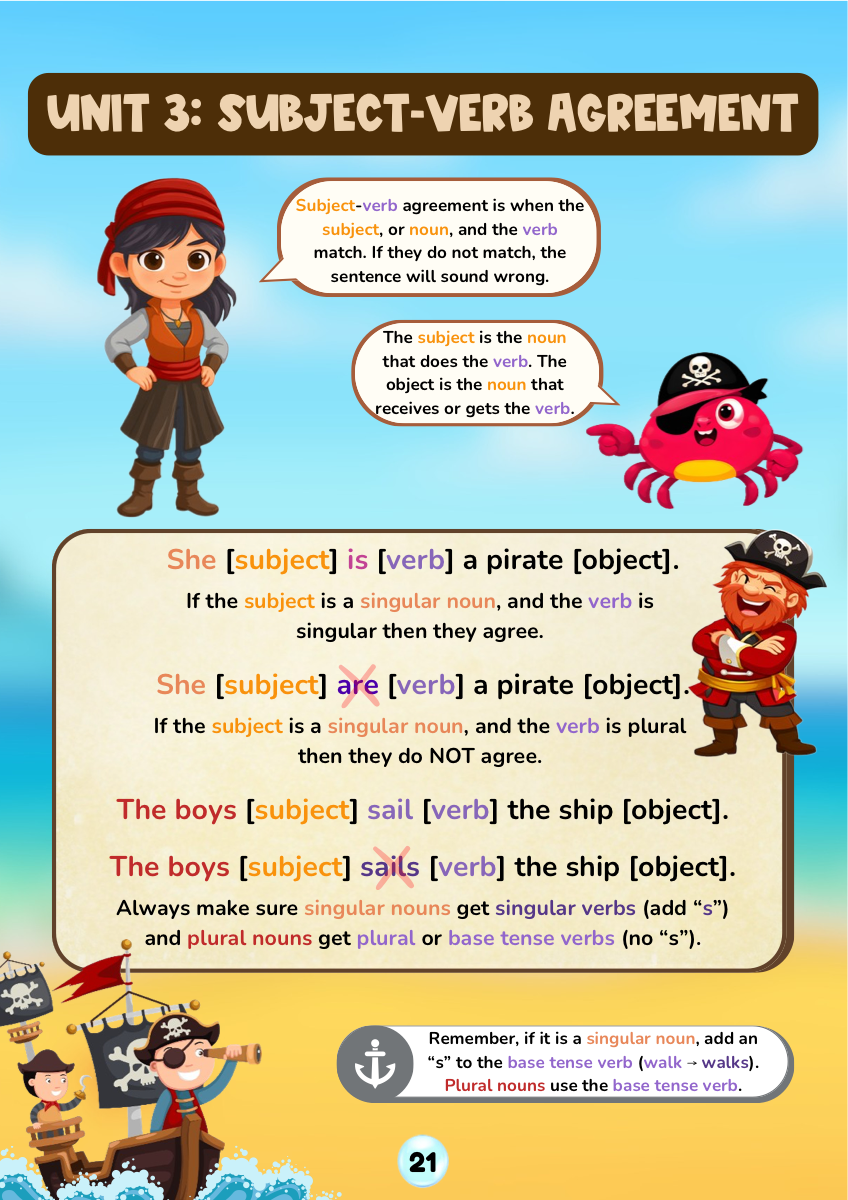
- Unit 3: Subject-Verb Agreement
Students learn:
Subjects and predicates
Matching verbs to subjects
Skills:
Correcting grammar errors
- Identifying agreement mistakes
- Writing grammatically correct sentences
- Unit 4: Regular Past Tense Verbs
Students learn:
Adding -ed
Adding -ied
Skills:
Changing present tense to past tense
- Identifying regular past tense verbs
- Editing and rewriting stories
- Unit 5: Irregular Past Tense Verbs
Students learn:
go → went
- eat → ate
- come → came
- run → ran
- build → built
Skills:
Memorizing common irregular verbs
- Writing about past events
- Using time words correctly
- Unit 6: Past Tense “Be” Verbs
Students learn:
was
were
Skills:
Describing events in the past
- Matching singular and plural subjects
- Reading and analyzing paragraphs
- Unit 7: Future Tense Verbs — Will
Students learn:
will + base verb
Skills:
Talking about future events
- Planning and prediction
- Using future time expressions
- Unit 8: Future Tense Verbs — Going To
Students learn:
is/am/are going to
Skills:
Discussing plans
- Asking future-tense questions
- Distinguishing plans from completed actions
- Unit 9: Verb Tense Review
Students review:
Past tense
- Present tense
- Future tense
Skills:
Identifying verb tenses
- Choosing correct tense forms
- Writing across different timelines
- Unit 10: Sentence Fragments
Students learn:
What makes a complete sentence
- Subjects
- Verbs
- Complete thoughts
Skills:
Fixing fragments
- Writing complete sentences
- Expanding ideas
- Unit 11: Compound Sentences
Students learn:
and
- but
- or
- so
- because
Skills:
Combining simple sentences
- Showing relationships between ideas
- Writing more sophisticated sentences
- Unit 12: Complex Sentences
Students learn:
Time phrases
- Place phrases
- Introductory clauses
- Comma usage
Skills:
Beginning sentences with time and place
- Combining information efficiently
- Writing more natural and varied sentences
- Educational Purpose
Volume 2 serves as a bridge between foundational grammar and true sentence-level writing. Students learn not only how grammar works but why it matters. By mastering verb tenses, sentence structure, and sentence combining, learners gain the tools needed to write clearer paragraphs, stronger stories, and more organized academic writing.
This volume is ideal for:
Elementary ESL/EFL learners
- Upper elementary writing programs
- Homeschool language arts
- Writing intervention programs
- Students preparing for paragraph writing and composition
- Skills Progression
- Grammar Foundations
- Present tense
- Past tense
- Future tense
- Be verbs
- Subject-verb agreement
⬇️
Sentence Construction
- Complete sentences
- Sentence fragments
- Editing and revision
⬇️
Advanced Writing
- Compound sentences
- Complex sentences
- Time and place transitions
⬇️
Paragraph Readiness
- Writing with variety
- Writing with clarity
- Writing with proper grammar
Writing · Basic
Writing Quest 2 Vol. 1: An Astronaut’s Adventure: From Sentences to Paragraphs
A creative writing program that teaches students how to ask questions, add details, expand sentences, and write with vivid sensory language through an exciting space adventure.
Writing Quest 2 Vol. 1: An Astronaut’s Adventure: From Sentences to Paragraphs
Writing Quest 2: An Astronaut’s Adventure (Volume 1)
A creative writing program that teaches students how to ask questions, add details, expand sentences, and write with vivid sensory language through an exciting space adventure.
Writing Quest 2: An Astronaut’s Adventure takes young writers on a mission across the galaxy as they help Astronaut Andy, Rover Roy, and the North Star stop Ava the Alien from stealing the powerful Galaxy Star. Along the journey, students learn how to transform simple sentences into rich, descriptive writing using questions, context, synonyms, sensory language, similes, and creative expression.
Unlike traditional grammar books that focus mainly on rules, this volume focuses on expanding ideas. Students learn how to ask better questions, gather details, describe experiences using all five senses, and create more engaging sentences and paragraphs.
The result is a writing curriculum that helps students move beyond basic sentence writing and begin writing with imagination, detail, and voice. 🚀✨
What Makes This Book Unique?
🚀 Writing Through Adventure
Students become space explorers on a mission to save Earth. Every lesson advances the story while building writing skills.
❓ Questions as a Writing Tool
Instead of treating questions only as grammar exercises, students learn how question words help writers gather information and add meaningful details to their writing.
📝 From Simple Sentences to Rich Descriptions
Students learn how to:
Expand ideas
- Add context
- Create compound and complex sentences
- Explain situations
- Write with greater detail and clarity
🌟 Full Sensory Writing Program
A major focus of the book is teaching students how to write using:
Smell
- Sight
- Sound
- Touch
- Taste
Students learn to use adjectives, similes, comparisons, and sensory details to create vivid descriptions.
🎨 Vocabulary and Creativity Development
The book introduces synonyms and descriptive language to help students avoid repetitive writing and develop stronger vocabulary.
Lesson Breakdown
Unit 1: Types of Sentences
Students learn:
Fragments
- Simple sentences
- Compound sentences
- Complex sentences
Skills:
Building complete thoughts
- Combining ideas
- Using conjunctions
- Using time and place phrases
- Unit 2: “Wh” + “H” Questions
Students learn:
Who
- What
- When
- Where
- Why
- How
Skills:
Asking questions
- Gathering information
- Writing detailed answers
- Restating information
- Unit 3: More Question Words
Students learn:
Can
- Could
- May
- Would
- Should
- Will
- Do
- Does
- Is
- Are
- Did
Skills:
Asking permission
- Asking opinions
- Asking factual questions
- Writing and answering questions
- Unit 4: Using Question Words to Add Details
Students learn how writers use questions to expand ideas.
Skills:
Sentence expansion
- Detail generation
- Compound sentence writing
- Complex sentence writing
- Supporting ideas with information
- Unit 5: Writing About Situations
Students learn:
When
- Before
- After
- If
Skills:
Showing sequence
- Showing cause and effect
- Creating context
- Writing more sophisticated sentences
- Unit 6: Synonyms
Students learn:
Stronger vocabulary choices
- Word families
- Shades of meaning
Example vocabulary:
big → huge, gigantic
- pretty → beautiful, marvelous
- bad → awful, dreadful
Skills:
Replacing repetitive words
- Expanding vocabulary
- Improving sentence variety
- The Five Senses Writing Series
The second half of the book focuses on one of the most important creative writing skills: sensory description.
Students learn to write using:
Adjectives
- Similes
- Comparisons
- Descriptive vocabulary
- Unit 7: Writing with Smell
Students learn:
smell + adjective
- smell like…
- smell as…as…
Skills:
Describing odors
- Using sensory details
- Creating vivid imagery
- Unit 8: Writing with Sight
Students learn:
look + adjective
- look like…
- look as…as…
Skills:
Visual description
- Observation
- Descriptive comparisons
- Unit 9: Writing with Sound
Students learn:
sound + adjective
- sound like…
- sound as…as…
Skills:
Auditory imagery
- Volume vocabulary
- Creative comparisons
- Unit 10: Writing with Touch
Students learn:
feel + adjective
- feel like…
- feel as…as…
Skills:
Texture vocabulary
- Physical description
- Sensory comparisons
- Unit 11: Writing with Taste
Students learn:
taste + adjective
- taste like…
- taste as…as…
Skills:
Flavor description
- Food vocabulary
- Figurative language
- Unit 12: Sensory Writing Review
Students combine:
Smell
- Sight
- Sound
- Touch
- Taste
Skills:
Multi-sensory writing
- Descriptive paragraphs
- Creative expression
- Stronger imagery
- Educational Purpose
This volume is designed to help students make the transition from writing simple sentences to creating rich, descriptive writing.
Students learn how to:
Ask meaningful questions
- Add details and context
- Expand sentences
- Use stronger vocabulary
- Write with sensory language
- Create vivid mental images for readers
These are the same foundational skills used by effective storytellers, essay writers, and creative writers.
Skills Progression
Building Information
Questions
⬇️
Expanding Ideas
Details & Situations
⬇️
Strengthening Vocabulary
Synonyms
⬇️
Creating Imagery
Five Senses Writing
⬇️
Creative Writing Readiness
Descriptive Paragraphs & Stories
Ideal For
- Elementary ESL/EFL learners
- Upper elementary writing classes
- Homeschool language arts
- Creative writing enrichment
- Students who struggle to add details when writing
- Learners preparing for paragraph and story writing
Writing · Basic
Writing Quest 2 Vol. 2: An Astronaut’s Adventure: From Sentences to Paragraphs
A complete introduction to paragraphs, story writing, narrative structure, and opinion writing through an exciting space-themed adventure.
Writing Quest 2 Vol. 2: An Astronaut’s Adventure: From Sentences to Paragraphs
Writing Quest: An Astronaut’s Adventure – Volume 2
A complete introduction to paragraphs, story writing, narrative structure, and opinion writing through an exciting space-themed adventure.
Writing Quest: An Astronaut’s Adventure Volume 2 takes students beyond sentence writing and into the world of paragraph writing, storytelling, and structured composition. As students continue their mission to stop Ava the Alien from obtaining the Galaxy Star, they learn how authors organize ideas, create memorable characters, build settings, develop story plots, and support opinions with reasons and evidence.
The book gradually guides students from writing simple paragraphs to creating complete short stories with beginnings, middles, and endings. By the end of the volume, students can also write organized informational and opinion-style paragraphs using reasons, examples, and supporting details.
What Makes This Book Unique?
🚀 Story Writing Made Simple
Many writing books ask students to write stories before teaching how stories actually work. This volume breaks storytelling into manageable pieces:
Paragraphs
- Story structure
- Story outlines
- Characters
- Settings
- Beginnings
- Middles
- Endings
Students build confidence step-by-step before writing full stories.
📝 Writing Through Planning
Students learn that good writers plan before they write.
The book introduces:
Story maps
- Outlines
- Character planning
- Setting planning
- Problem and solution planning
These tools help students organize ideas before beginning longer writing tasks.
🌟 Strong Focus on Narrative Writing
The heart of this volume is teaching students how stories work.
Students learn:
Character
- Setting
- Problem
- Solution
- Conflict
- Story flow
- Story endings
This creates a strong foundation for future creative writing.
💡 Introduction to Academic Writing
The second half of the book transitions toward informational and opinion writing.
Students learn:
Main ideas
- Reasons
- Supporting details
- Evidence
- Examples
- Paragraph organization
These are foundational skills for future essay writing.
🎨 Guided Creativity
Unlike open-ended writing programs that overwhelm students, each lesson provides:
Models
- Examples
- Graphic organizers
- Guided questions
- Structured support
Students are creative while still receiving clear guidance.
Lesson Breakdown
Unit 1: Paragraphs
Students learn:
What a paragraph is
- Topic consistency
- Main ideas
- Indentation
- Paragraph structure
Skills:
Identifying paragraph topics
- Grouping related ideas
- Organizing information
- Unit 2: Introduction to Short Stories
Students learn:
Beginning
- Middle
- End
- Character
- Setting
- Problem
- Solution
Skills:
Story sequencing
- Understanding narrative structure
- Recognizing story elements
- Unit 3: Story Outlines
Students learn:
Story planning
- Character planning
- Setting planning
- Problem and solution planning
Skills:
Organizing ideas before writing
- Creating story maps
- Planning complete narratives
- Unit 4: Characters and Setting
Students learn how to create detailed:
Characters
Settings
Skills:
Using sensory details
- Asking descriptive questions
- Character development
- World building
- Unit 5: Writing Beginnings
Students learn:
Story openings
- Genre awareness
- Character introductions
- Setting introductions
Genres include:
Fairy tales
- Fantasy
- Science fiction
- Mystery
- Adventure
Skills:
Hooking readers
- Introducing stories effectively
- Unit 6: Writing Middles
Students learn:
Creating conflict
- Introducing problems
- Building suspense
- Using transition words
Skills:
Story development
- Sequencing events
- Creating tension
- Unit 7: Writing Endings Part 1
Students learn:
Resolving problems
- Creating satisfying endings
- Answering readers’ questions
Skills:
Story resolution
- Narrative closure
- Strong conclusions
- Unit 8: Writing Endings Part 2
Students explore different ending types:
😊 Happy Endings
Problems are solved.
😢 Sad Endings
Characters lose something important.
😂 Funny Endings
Readers laugh.
🔍 Mysterious Endings
Questions remain unanswered.
Skills:
Tone
- Audience impact
- Creative storytelling choices
- Unit 9: Short Story Review
Students combine all previous narrative skills:
Character
- Setting
- Beginning
- Middle
- End
- Conflict
- Resolution
Students write complete short stories.
Transition to Informational Writing
After mastering storytelling, students learn how to explain ideas clearly.
Unit 10: Adding Reasons and Details Part 1
Students learn:
Main ideas
- Reasons
- Supporting details
- Evidence
Skills:
Answering “why” questions
- Supporting opinions
- Giving examples
Structure:
Main Idea
- Reason 1
- Support 1
- Reason 2
- Support 2
- Reason 3
- Support 3
- Unit 11: Adding Reasons and Details Part 2
Students learn how to turn outlines into complete paragraphs.
Skills:
Paragraph organization
- Logical sequencing
- Evidence-based writing
- Informational writing
Students practice using:
First
- Next
- Then
- Finally
- For example
- For instance
- To illustrate
- Unit 12: All About Me Writing Project
Students apply everything they have learned to write a structured personal paragraph.
Skills:
Personal writing
- Self-expression
- Main idea development
- Supporting details
- Organized paragraph writing
This serves as a culminating writing project.
Educational Progression
Stage 1
Paragraph Writing
⬇️
Stage 2
Story Structure
⬇️
Stage 3
Story Planning
⬇️
Stage 4
Narrative Writing
⬇️
Stage 5
Reasons & Evidence
⬇️
Stage 6
Paragraph Composition
⬇️
Stage 7
Personal & Opinion Writing
This progression mirrors how developing writers naturally grow from storytelling into academic writing.
Educational Purpose
This volume serves as a bridge between beginner writing and more advanced composition.
Students learn how to:
Organize ideas into paragraphs
- Plan and write complete stories
- Develop characters and settings
- Build logical story structure
- Support ideas with reasons and evidence
- Write organized informational paragraphs
By the end of the book, students move from writing individual sentences to creating complete, organized pieces of writing with clear structure and purpose.
Ideal For
- Upper elementary ESL/EFL learners
- Students transitioning from sentence writing to paragraph writing
- Creative writing classes
- Homeschool language arts
- Young authors
- Students preparing for essay writing
Grammar · Basic
Grammar Hammer Adventures: Book 1: Vol 1
Grammar Hammer Book 1 transforms grammar instruction into an exciting fantasy adventure where students join Stan, Jan, and their mentor Wordy the Wise on a quest to stop the evil Erazer Head from d…
Grammar Hammer Adventures: Book 1: Vol 1



Grammar Hammer Book 1: The Quest Begins
Volume 1 – Unleashing the Power of Nouns and Pronouns
Grammar Hammer Book 1 transforms grammar instruction into an exciting fantasy adventure where students join Stan, Jan, and their mentor Wordy the Wise on a quest to stop the evil Erazer Head from destroying grammar itself. Along the way, students master foundational grammar concepts including nouns, plural nouns, pronouns, apostrophes, and possessives while uncovering the mystery of a giant letter “A” that has fallen from the sky.
Rather than teaching grammar through isolated drills, the book weaves every lesson into an ongoing narrative that gives students a reason to care about grammar. Each new skill becomes a tool that helps the heroes progress on their journey and prepare for future battles against grammatical chaos.
What Makes This Book Unique?
⚒️ Grammar as an Adventure Story
Most grammar books present rules and exercises. Grammar Hammer turns grammar into a quest.
Students:
Follow recurring characters
- Solve grammar challenges
- Meet villains and allies
- Unlock new grammar powers
- Progress through a larger story
The narrative framework makes grammar feel meaningful and memorable.
📖 Context-Based Grammar Learning
Instead of learning rules in isolation, students encounter grammar concepts naturally through story events and dialogue.
For example:
- The giant “A” introduces articles.
- Erazer Head’s army introduces plural nouns.
- The giant “A” teaches pronouns.
- Flying apostrophes teach contractions and possession.
Grammar concepts are embedded in meaningful situations.
🏗️ Strong Foundation Before Complexity
Volume 1 focuses on the most important building blocks of English grammar:
Nouns
- Plurals
- Pronouns
- Be verbs
- Negative be verbs
- Apostrophes
- Possessives
Students build mastery before moving into more advanced grammar concepts in later volumes.
🎯 High Practice Density
Every lesson includes:
Guided instruction
- Examples
- Story integration
- Multiple practice activities
- Sentence-building exercises
- Review quizzes
Students repeatedly apply each grammar concept in different ways.
🧠 Grammar and Writing Connection
The book constantly reinforces that grammar exists to help people communicate clearly.
Students don’t simply memorize rules—they use grammar to:
Build sentences
- Explain ideas
- Tell stories
- Communicate accurately
This creates stronger long-term retention.
Lesson Breakdown
Unit 1: Introduction to Grammar Hammer
Students are introduced to:
Nouns
- Verbs
- Adjectives
Skills:
Identifying parts of speech
- Building sentences
- Understanding basic grammar categories
Story Focus:
Stan and Jan discover the mysterious giant “A.”
Unit 2: Nouns
Students learn:
What nouns are
- Person
- Place
- Thing
- Animal
- Plant
Students also learn:
Articles (a, an, the)
Singular nouns
Skills:
Noun classification
- Correct article usage
- Sentence construction
- Unit 3: Plural Nouns
Students learn:
Singular vs. plural nouns
- Adding -s
- Adding -es
Skills:
Forming regular plurals
- Recognizing spelling patterns
- Using plurals in sentences
Examples include:
rocks
- boxes
- benches
- foxes
- Unit 4: Irregular Plural Nouns
Students learn:
children
- men
- women
- mice
- geese
- people
- feet
- teeth
Students also learn:
f → ves changes
- leaf → leaves
- wolf → wolves
- knife → knives
Skills:
Recognizing irregular patterns
- Applying irregular plurals correctly
- Unit 5: Review Quiz
Students review:
Nouns
- Regular plurals
- Irregular plurals
Skills:
Grammar mastery
- Independent application
- Cumulative review
- Unit 6: Subject Pronouns
Students learn:
I
- You
- He
- She
- It
- We
- They
Skills:
Replacing nouns with pronouns
- Avoiding repetition
- Pronoun identification
Story Focus:
The giant “A” introduces the importance of choosing pronouns correctly.
Unit 7: Subject Pronouns + Be Verbs
Students learn:
I am
- He is
- She is
- It is
- You are
- We are
- They are
Skills:
Subject-verb agreement
- Sentence building
- Describing people and things
- Unit 8: Subject Pronouns + Negative Be Verbs
Students learn:
am not
- is not
- are not
Skills:
Creating negative sentences
- Understanding opposites
- Building complete statements
Examples:
- He is not tired.
- We are not lost.
- They are not bored.
- Unit 9: Pronoun Review Quiz
Students review:
Subject pronouns
- Be verbs
- Negative be verbs
Skills:
Sentence correction
- Pronoun mastery
- Grammar fluency
- Unit 10: Apostrophes
Students learn two major apostrophe functions:
Contractions
- I’m
- He’s
- She’s
- It’s
- We’re
- They’re
- Ownership
- Sarah’s book
- Tom’s pencil
- Dog’s bone
Skills:
Recognizing contractions
- Creating contractions
- Showing possession
- Unit 11: Possessive Endings
Students learn:
his
hers
Skills:
Ownership
- Possessive language
- Reading comprehension
Story Focus:
Students learn about the legendary Grammar Hammer while meeting Grainy the Great and discovering more about Erazer Head’s plans.
Educational Progression
Stage 1
Parts of Speech
⬇️
Stage 2
Nouns
⬇️
Stage 3
Plural Forms
⬇️
Stage 4
Pronouns
⬇️
Stage 5
Be Verbs
⬇️
Stage 6
Negative Sentences
⬇️
Stage 7
Apostrophes & Possession
This progression carefully develops grammar knowledge in a logical order, ensuring students master one concept before building on it.
Educational Purpose
The primary purpose of Grammar Hammer Book 1 is to establish a strong grammatical foundation for young learners.
Students learn how to:
Identify parts of speech
- Recognize and classify nouns
- Form singular and plural nouns
- Use pronouns correctly
- Match pronouns with be verbs
- Create negative sentences
- Use apostrophes properly
- Show possession
By mastering these core concepts, students gain the grammar tools needed for stronger reading, writing, speaking, and future language study.
Ideal For
- Elementary ESL/EFL learners
- Beginning grammar students
- Homeschool language arts programs
- Supplementary grammar instruction
- Students who dislike traditional grammar worksheets
- Young readers who enjoy stories and fantasy adventures
Grammar · Basic
Grammar Hammer Adventures Book 1: Vol 2
Grammar Hammer Book 2 continues the adventure of Stan, Jan, and Wordy the Wise as they search for the giant letters "B" and "E" to unlock the power of the legendary Grammar Hammer. Along the way, s…
Grammar Hammer Adventures Book 1: Vol 2
Grammar Hammer Book 1: The Power of Description and Questions
Volume 2 – Adjectives, Questions, and Prepositions
Grammar Hammer Book 2 continues the adventure of Stan, Jan, and Wordy the Wise as they search for the giant letters “B” and “E” to unlock the power of the legendary Grammar Hammer. Along the way, students learn how to describe nouns with adjectives, ask increasingly detailed questions, and use prepositions to explain time, place, and relationships between objects.
As the heroes travel across deserts, circuses, haunted houses, and mysterious worlds, students develop essential sentence-building skills that help them communicate more clearly and confidently in English. Every grammar concept becomes a practical tool that helps the characters move closer to stopping the evil Erazer Head and restoring order to Planet ABC-123456789.
What Makes This Book Unique?
Grammar Through Storytelling
Rather than learning grammar through disconnected worksheets, students learn alongside recurring characters in an ongoing fantasy adventure.
Students:
Follow Stan, Jan, and Wordy the Wise on their quest
- Raise and train an Adj-Dragon
- Search for the giant letters “B” and “E”
- Solve grammar challenges that advance the story
- Discover how grammar helps restore order to Planet ABC-123456789
The narrative framework gives students a meaningful reason to engage with grammar concepts and creates stronger retention through context.
A Focus on Descriptive Language
This volume introduces students to the power of adjectives and detailed communication.
Students learn how to:
Describe people, places, and objects
- Use adjectives with be verbs
- Place adjectives before nouns
- Identify and compare objects using demonstrative adjectives
These skills help students create richer and more precise sentences.
Building Strong Question Skills
Students move beyond simple statements and learn how to ask effective questions.
They learn:
Be verb questions
- Yes/No questions
- WH-questions
- WH-questions with prepositions
These structures help students participate in conversations, gather information, and strengthen reading comprehension.
Grammar for Real Communication
Every lesson emphasizes how grammar is used in everyday communication.
Students learn how to:
Ask for information
- Describe locations
- Explain time and place
- Clarify meaning
- Give more detailed responses
- Communicate accurately and confidently
Grammar is presented as a tool for communication rather than a collection of isolated rules.
Structured Skill Progression
Each lesson builds naturally on previous concepts.
Students progress from:
Adjectives
⬇
Descriptive Sentences
⬇
Be Verb Questions
⬇
Yes/No Questions
⬇
WH Questions
⬇
Prepositions
⬇
Time and Place Expressions
This progression allows students to develop increasingly sophisticated communication skills while maintaining confidence and mastery.
Lesson Breakdown
Unit 1: Be Verbs + Adjectives
Students learn:
Adjectives
- Sensory descriptions
- Be verbs with adjectives
Skills:
Describing appearance, feelings, and characteristics
- Using adjectives in complete sentences
- Connecting adjectives to the five senses
Story Focus:
Stan, Jan, and Wordy discover a mysterious Adj-Dragon egg while searching for the giant “B.”
Unit 2: Adjectives Before a Noun
Students learn:
Adjective placement
Descriptive noun phrases
Skills:
Using adjectives before nouns
- Expanding sentence detail
- Creating more vivid descriptions
Examples include:
colorful egg
- shy dragon
- smart dragon
- giant cactus
- Unit 3: Demonstrative Adjectives
Students learn:
this
- that
- these
- those
Skills:
Identifying singular and plural nouns
- Distinguishing between near and far objects
- Matching demonstrative adjectives with nouns
Story Focus:
Multiple Adj-Dragons hatch, and students learn how to identify and describe them correctly.
Unit 4: Review Quiz
Students review:
Adjectives
- Be verbs
- Demonstrative adjectives
Skills:
Grammar application
- Sentence building
- Cumulative review
- Unit 5: Be Verb Questions
Students learn:
Am I…?
- Is he…?
- Are they…?
Skills:
Transforming statements into questions
- Asking about people, places, and situations
- Gathering information through questioning
Story Focus:
Goldie the Adj-Dragon only understands questions that begin with be verbs.
Unit 6: Yes/No Questions
Students learn:
Do
- Does
- Did
- Is
- Are
- Can
- Will
- Have
Skills:
Forming yes/no questions
- Confirming information
- Understanding question structure across multiple tenses
Story Focus:
The giant “B” only answers with yes or no, forcing students to improve their questioning skills.
Unit 7: The Five W Questions
Students learn:
Who
- What
- When
- Where
- Why
Skills:
Gathering detailed information
- Strengthening comprehension
- Asking meaningful questions
Story Focus:
The giant “B” begins providing clues about the missing giant “E.”
Unit 8: Review Quiz
Students review:
Be verb questions
- Yes/No questions
- WH questions
Skills:
Question formation
- Grammar accuracy
- Independent application
- Unit 9: WH Questions + Prepositions
Students learn:
who … with?
- where … from?
- what … about?
- who … to?
Skills:
Asking more specific questions
- Understanding relationships and locations
- Expanding question complexity
Story Focus:
The search for the giant “E” leads the heroes to a circus and a haunted house.
Unit 10: Prepositions in Statements
Students learn:
in
- on
- under
- over
- between
- against
- by
- with
Skills:
Describing location
- Understanding spatial relationships
- Building more precise sentences
- Unit 11: Time and Place with Prepositions
Students learn:
in
- on
- at
Skills:
Talking about dates
- Talking about time
- Talking about locations
Examples include:
in summer
- on Monday
- at 7:00
Story Focus:
The heroes finally find the giant “E” and prepare to reunite him with the giant “B.”
Educational Progression
Stage 1
Descriptive Language
⬇
Stage 2
Adjectives and Nouns
⬇
Stage 3
Demonstrative Adjectives
⬇
Stage 4
Be Verb Questions
⬇
Stage 5
Yes/No Questions
⬇
Stage 6
WH Questions
⬇
Stage 7
Prepositions
⬇
Stage 8
Time and Place Expressions
Educational Purpose
The primary purpose of Grammar Hammer Book 2 is to help students move beyond basic sentence construction and begin communicating with greater precision and detail.
Students learn how to:
Describe nouns accurately
- Use adjectives naturally
- Ask meaningful questions
- Gather information through conversation
- Understand location and direction
- Use prepositions correctly
- Communicate more effectively in spoken and written English
By mastering these skills, students build a stronger foundation for reading comprehension, writing, speaking, and future grammar study.
Ideal For
- Elementary ESL/EFL learners
- Students transitioning from foundational grammar to sentence expansion
- Homeschool language arts programs
- Supplementary grammar instruction
- Learners developing conversation skills
- Students who enjoy story-based learning
- Young readers preparing for more advanced grammar and writing instruction
Grammar Hammer Book 2 combines grammar instruction, storytelling, and communication practice into a structured adventure that helps students develop both grammatical accuracy and practical language skills.
Grammar · Basic
Grammar Hammer Adventures Book 1: Vol 3
Grammar Hammer Book 3 continues the journey of Stan, Jan, and Wordy the Wise as they move closer than ever to finding the legendary Grammar Hammer. Along the way, students learn how English uses pr…
Grammar Hammer Adventures Book 1: Vol 3
Grammar Hammer Book 1: The Search for the Grammar Hammer
Volume 3 – Pronouns, Existence, and Conjunctions
Grammar Hammer Book 3 continues the journey of Stan, Jan, and Wordy the Wise as they move closer than ever to finding the legendary Grammar Hammer. Along the way, students learn how English uses pronouns to talk about weather, time, animals, plants, and objects. They also master sentence patterns with there is and there are, learn how to ask questions about existence, and discover how conjunctions connect ideas together.
As the adventure unfolds through deserts, caves, ancient ruins, magical tunnels, and forgotten palaces, students develop stronger sentence-building skills while learning how grammar helps people describe the world, explain ideas, and connect information clearly. Every new grammar concept becomes a tool that helps the heroes move one step closer to stopping Erazer Head and restoring grammar to Planet ABC-123456789.
What Makes This Book Unique?
Grammar Through Adventure
Grammar Hammer continues its story-driven approach by turning grammar into a quest rather than a collection of worksheets.
Students:
Travel with Stan, Jan, and Wordy the Wise
- Meet magical creatures and ancient guardians
- Explore caves, deserts, palaces, and libraries
- Solve grammar challenges to advance the story
- Search for the legendary Grammar Hammer
Each grammar lesson directly supports the larger narrative, helping students understand grammar in context.
Expanding Sentence Building Skills
This volume introduces several sentence structures that students use constantly in real communication.
Students learn how to:
Talk about weather and time
- Describe animals, plants, and objects using pronouns
- Explain what exists and where things are
- Connect ideas with conjunctions
- Express reasons, results, and purposes
These skills help students move from simple sentences toward more sophisticated communication.
Connecting Grammar to Real Language
Students learn grammar as a tool for expressing ideas rather than simply memorizing rules.
They practice how to:
Describe daily situations
- Explain causes and effects
- Give reasons
- Ask questions
- Discuss existence and location
- Connect multiple ideas within a sentence
The result is stronger speaking, writing, and reading comprehension skills.
A Focus on Logical Thinking
Many of the lessons teach students how ideas connect.
Students learn:
Cause and effect
- Purpose and intention
- Comparison and contrast
- Choice and alternatives
- Existence and location
These skills support both grammar development and critical thinking.
Structured Skill Progression
Each unit builds upon previously learned concepts.
Students progress from:
Pronouns and Weather
⬇
Pronouns and Time
⬇
Singular and Plural References
⬇
Existence Statements
⬇
Existence Questions
⬇
Negative Existence
⬇
Basic Conjunctions
⬇
Cause and Effect
⬇
Purpose and Intent
This progression helps students build increasingly complex and natural English sentences.
Lesson Breakdown
Unit 1: “It” for Weather
Students learn:
- It is sunny.
- It is cloudy.
- It is raining.
- It is snowing.
Skills:
Describing weather conditions
- Using “it” as a placeholder subject
- Forming weather statements and questions
Story Focus:
The giant “BE” demonstrates its power by transforming into weather phenomena and teaching students how English describes weather.
Unit 2: “It” for Time
Students learn:
- It is morning.
- It is lunchtime.
- It is time to leave.
- It has been a long time.
Skills:
Talking about time and schedules
- Describing times of day
- Discussing duration and activities
Story Focus:
Stan and Jan continue their journey through the desert while learning how English uses “it” to talk about time.
Unit 3: “It” and “They” for Animals, Plants, and Objects
Students learn:
- It is a fox.
- It is a cactus.
- They are foxes.
- They are cacti.
Skills:
Singular and plural pronouns
- Subject-pronoun agreement
- Describing objects, animals, and plants
Story Focus:
The heroes meet the mysterious desert fox and follow clues that may lead them to the Grammar Hammer.
Unit 4: Review Quiz
Students review:
It for weather
- It for time
- It and they for nouns
Skills:
Pronoun mastery
- Sentence construction
- Grammar review
- Unit 5: There Is, There Are
Students learn:
- There is a cactus.
- There are camels.
- There is treasure.
- There are many clues.
Skills:
Expressing existence
- Distinguishing singular and plural nouns
- Introducing information clearly
Story Focus:
Inside a treasure-filled cave, students learn how to describe what exists around them.
Unit 6: Is There, Are There?
Students learn:
Is there a flower?
- Are there footprints?
- Is there a way out?
- Are there animals nearby?
Skills:
Asking questions about existence
- Using singular and plural forms correctly
- Gathering information
Story Focus:
The heroes become lost inside a magical cave and must use grammar to find their way out.
Unit 7: Isn’t There, Aren’t There?
Students learn:
- There isn’t any milk.
- There aren’t any cookies.
- Isn’t there a clue?
- Aren’t there any signs?
Skills:
Negative statements
- Negative questions
- Contractions
- Understanding absence and nonexistence
Story Focus:
A magical tunnel challenges the heroes to master negative existence forms before they can escape.
Unit 8: Review Quiz
Students review:
There is / There are
- Is there / Are there
- Isn’t there / Aren’t there
Skills:
Question formation
- Sentence accuracy
- Grammar application
- Unit 9: And, But, Or
Students learn:
and
- but
- or
Skills:
Combining ideas
- Showing contrast
- Presenting choices
- Building compound sentences
Story Focus:
A magic genie teaches the heroes important lessons about conjunctions while helping them search for the Grammar Hammer.
Unit 10: So, Because
Students learn:
Cause and effect relationships
- Giving reasons
- Explaining actions
Examples include:
- I was thirsty, so I drank water.
- I smiled because I was happy.
Skills:
Logical sentence building
- Explaining ideas
- Understanding reasons and results
Story Focus:
The Grammar Hammer begins to reveal its power as students learn how ideas connect through cause and effect.
Unit 11: So, So That
Students learn:
so
so that
Skills:
Expressing purpose
- Explaining goals and intentions
- Distinguishing between result and purpose
Examples include:
- It was hot, so we drank water.
- We brought umbrellas so that we would stay dry.
Story Focus:
The heroes discover clues leading toward the Time Gate and prepare for their eventual confrontation with Erazer Head.
Educational Progression
Stage 1
Weather and Time Expressions
⬇
Stage 2
Pronouns for Objects and Animals
⬇
Stage 3
Existence Statements
⬇
Stage 4
Existence Questions
⬇
Stage 5
Negative Existence
⬇
Stage 6
Basic Conjunctions
⬇
Stage 7
Cause and Effect
⬇
Stage 8
Purpose and Intent
Educational Purpose
The primary purpose of Grammar Hammer Book 3 is to help students develop more natural and connected English sentences.
Students learn how to:
Use pronouns accurately
- Describe weather and time
- Express existence and location
- Ask questions about what exists
- Create negative statements and questions
- Connect ideas with conjunctions
- Explain reasons and results
- Express goals and purposes
By mastering these structures, students strengthen their reading comprehension, speaking ability, writing fluency, and overall grammatical confidence.
Ideal For
- Elementary ESL/EFL learners
- Students transitioning from foundational grammar to paragraph-level writing
- Homeschool language arts programs
- Supplementary grammar instruction
- Learners developing stronger sentence-combining skills
- Students preparing for more advanced grammar and composition
- Young readers who enjoy story-based learning
Grammar Hammer Book 3 combines grammar instruction, storytelling, and communication practice into a structured adventure that helps students understand not only how English works, but why grammar matters when expressing ideas clearly and effectively.
Grammar · Basic
Grammar Hammer Adventures Book 1: Vol 4
Grammar Hammer Book 1 concludes the first stage of Stan, Jan, and Wordy the Wise’s journey as they travel through ancient jungles, forgotten temples, and mysterious ruins in search of the Time Gate…
Grammar Hammer Adventures Book 1: Vol 4
Grammar Hammer Book 1: Tenses, Adverbs, and Time Travel
Volume 4 – Present Tense, Past Tense, Adverbs, and Qualifiers
Grammar Hammer Book 1 concludes the first stage of Stan, Jan, and Wordy the Wise’s journey as they travel through ancient jungles, forgotten temples, and mysterious ruins in search of the Time Gate. Along the way, students learn how English uses verb tenses to talk about the present and the past, how adverbs add detail to actions, and how qualifiers strengthen descriptions.
As Erazer Head continues to erase important grammar rules from Planet ABC-123456789, students develop the skills needed to describe habits, ask questions, tell stories about the past, and communicate with greater precision. Through each lesson, grammar becomes an essential tool that helps the heroes move closer to becoming true Grammar Masters.
What Makes This Book Unique?
Grammar Through Adventure
Students continue following the ongoing story of Stan, Jan, and Wordy the Wise as they travel toward the mysterious Time Gate.
Along the way they:
Chase magical letters through the desert
- Meet talking trees and ancient temples
- Explore a prehistoric jungle from the past
- Discover hidden treasures and ancient libraries
- Practice grammar to help stop Erazer Head
Every lesson is woven directly into the story, giving grammar concepts a meaningful purpose and context.
A Strong Foundation in Verb Tenses
This volume focuses heavily on helping students understand when actions happen.
Students learn how to:
Describe habits and routines
- Talk about events happening now
- Explain actions that happened in the past
- Ask questions about present and past events
- Use both regular and irregular past tense verbs
These skills form the foundation for reading, writing, and conversation.
Building Better Sentences
Students move beyond basic sentence construction and begin adding greater detail to their writing.
They learn how to:
Use adverbs to describe actions
- Express frequency and routine
- Strengthen descriptions with qualifiers
- Write more vivid and engaging sentences
The result is language that sounds more natural, expressive, and sophisticated.
Practical Communication Skills
The grammar taught in this volume reflects structures students use every day.
Students practice:
Talking about routines
- Asking questions
- Describing past experiences
- Explaining how actions happen
- Expressing how often something occurs
- Making descriptions stronger and more precise
These skills support real-world communication rather than isolated grammar drills.
Structured Skill Progression
Each lesson builds naturally upon previous learning.
Students progress from:
Simple Present Tense
⬇
Present-Tense Questions
⬇
Regular Past Tense
⬇
Irregular Past Tense
⬇
Past-Tense Questions
⬇
Adverbs
⬇
Adverbs of Frequency
⬇
Qualifiers
This progression helps students develop confidence while steadily increasing grammatical complexity.
Lesson Breakdown
Unit 1: Simple Present Tense
Students learn:
Habitual actions
- Facts and general truths
- Subject-verb agreement
- Adding s, es, and ies
Skills:
Describing daily routines
- Writing factual statements
- Using present tense accurately
Story Focus:
The heroes discover that Erazer Head is erasing the letter “S,” threatening many important present-tense grammar rules.
Unit 2: Yes/No Questions with Short Answers
Students learn:
Do questions
- Does questions
- Short answers
- Helping verbs
Skills:
Asking present-tense questions
- Responding with complete short answers
- Understanding question structure
Story Focus:
A magical Do-Does Tree helps students practice answering questions with complete responses rather than simple yes or no answers.
Unit 3: Regular Past Tense
Students learn:
Adding -ed to verbs
- Describing completed actions
- Past-tense storytelling
Skills:
Talking about events in the past
- Forming regular past-tense verbs
- Understanding time relationships
Story Focus:
The heroes discover a mysterious floating “ed” that may help lead them to the Time Gate.
Unit 4: Review Quiz
Students review:
Simple present tense
- Present-tense questions
- Regular past tense
Skills:
Grammar mastery
- Sentence editing
- Verb tense recognition
- Unit 5: Irregular Past Tense Part 1
Students learn:
went
- saw
- came
- found
- sang
- ate
and other common irregular verbs.
Skills:
Memorizing irregular forms
- Talking about past events
- Recognizing non-standard verb changes
Story Focus:
The heroes enter a magical history book and discover that the desert was once a lush jungle.
Unit 6: Irregular Past Tense Part 2
Students learn:
was
- were
- had
- did
Skills:
Using common irregular past-tense verbs
- Understanding past-tense be verbs
- Describing past conditions and actions
Story Focus:
The heroes cross a river using magical verbs that transform into a bridge.
Unit 7: Past Tense Yes/No Questions
Students learn:
Was
- Were
- Did
Skills:
Asking questions about the past
- Switching word order
- Gathering information about past events
Story Focus:
A giant talking temple challenges the heroes to ask questions about ancient history.
Unit 8: Review Quiz
Students review:
Regular past tense
- Irregular past tense
- Past-tense questions
Skills:
Verb tense accuracy
- Question formation
- Grammar review
- Unit 9: Adverbs
Students learn:
quickly
- softly
- happily
- quietly
- brightly
Skills:
Describing how actions happen
- Forming adverbs with -ly and -ily
- Expanding sentence detail
Story Focus:
The heroes discover a giant “LY” hidden among the treasures of an ancient temple.
Unit 10: Adverbs of Frequency
Students learn:
always
- usually
- often
- sometimes
- seldom
- rarely
- never
Skills:
Describing routines and habits
- Expressing frequency
- Understanding time-related language
Story Focus:
A room filled with clocks helps students understand how often actions happen.
Unit 11: Qualifiers
Students learn:
very
- really
- quite
- too
- extremely
- so
- pretty
Skills:
Strengthening descriptions
- Modifying adjectives
- Modifying adverbs
- Writing with greater precision
Examples include:
extremely hot
- very happy
- really slowly
- quite loudly
Story Focus:
The heroes prepare for the final stage of their journey while learning how qualifiers add power and detail to language.
Educational Progression
Stage 1
Present-Tense Communication
⬇
Stage 2
Present-Tense Questions
⬇
Stage 3
Regular Past Tense
⬇
Stage 4
Irregular Past Tense
⬇
Stage 5
Past-Tense Questions
⬇
Stage 6
Adverbs of Manner
⬇
Stage 7
Adverbs of Frequency
⬇
Stage 8
Qualifiers and Sentence Expansion
Educational Purpose
The primary purpose of Grammar Hammer Book 1 Volume 4 is to help students communicate across time by mastering both present and past verb forms while expanding their ability to describe actions and ideas.
Students learn how to:
Use simple present tense accurately
- Form and answer yes/no questions
- Use regular and irregular past tense verbs
- Ask questions about past events
- Describe actions using adverbs
- Express frequency and routine
- Strengthen descriptions using qualifiers
- Write richer and more expressive sentences
By mastering these skills, students gain the grammatical foundation necessary for more advanced writing, reading comprehension, storytelling, and conversation.
Ideal For
- Elementary ESL/EFL learners
- Students developing verb tense mastery
- Learners transitioning from basic grammar to paragraph-level writing
- Homeschool language arts programs
- Supplemental grammar instruction
- Students preparing for more advanced grammar and composition
- Young learners who enjoy story-based learning
Grammar Hammer Book 1 Volume 4 combines verb tense instruction, sentence expansion, and storytelling into an adventure that helps students communicate more clearly, accurately, and confidently while preparing them for the next stage of the Grammar Hammer journey.
Grammar · Basic
Grammar Hammer Adventures Book 2: Vol 1
Grammar Hammer Book 2 continues the exciting adventure of Stan, Jan, and Wordy the Wise as they travel through time, journey into the future, and move closer than ever to confronting Erazer Head. A…
Grammar Hammer Adventures Book 2: Vol 1
Grammar Hammer Book 2: The Fight for Grammar
Volume 1 – Discovering Past, Present, and Future Tenses
Grammar Hammer Book 2 continues the exciting adventure of Stan, Jan, and Wordy the Wise as they travel through time, journey into the future, and move closer than ever to confronting Erazer Head. Armed with the powerful Grammar Hammer, the heroes must repair damaged Time Gates, restore missing grammar rules, and stop the Super Mistake Maker laser before all language is lost forever.
Along the way, students learn how English uses present, past, and future tenses to describe actions across time. They master question formation, progressive tenses, future expressions, and verb agreement while exploring futuristic cities, ancient jungles, magical caves, and distant planets. By combining storytelling with structured grammar instruction, students develop a deeper understanding of how English communicates when actions happen and how ideas connect across time.
What Makes This Book Unique?
Grammar Through Science-Fiction Adventure
Grammar Hammer expands beyond deserts and jungles into a larger universe filled with:
Time travel
- Future civilizations
- Floating cities
- Ancient temples
- Magical portals
- Space exploration
Students learn grammar while helping Stan and Jan repair the damage caused by Erazer Head.
A Complete Introduction to English Verb Tenses
This volume focuses on one of the most important foundations in English: time.
Students learn how to:
Describe actions happening now
- Talk about routines and habits
- Discuss completed actions
- Explain future plans and predictions
- Describe actions in progress
- Ask questions about past, present, and future events
These skills form the backbone of everyday communication.
Strong Focus on Question Formation
Students repeatedly practice gathering information through questions.
They learn:
Do and does questions
- Five W questions
- Present-tense questioning
- Past-tense questioning
- Question-answer relationships
This strengthens both speaking and reading comprehension skills.
Building Real Communication Skills
Students learn language they can immediately use in conversations, writing assignments, and presentations.
They practice:
Asking for information
- Making predictions
- Describing plans
- Telling stories
- Explaining events
- Discussing possibilities
- Logical Skill Progression
The curriculum gradually expands students’ understanding of time.
Students progress from:
Present Tense
⬇
Present Questions
⬇
Present Progressive
⬇
Future Tense
⬇
Future Expressions
⬇
Past Tense Review
⬇
Irregular Past Tense
⬇
Past Progressive
This structure helps students understand how English organizes events across time.
Lesson Breakdown
Unit 1: Previously in Grammar Hammer – Review
Students review:
Nouns
- Verbs
- Helping verbs
- Be verbs
- Adjectives
- Adverbs
Skills:
Parts of speech identification
- Sentence construction
- Grammar review
Story Focus:
Stan and Jan review everything they learned during their first adventure before continuing their mission to save Planet ABC-123456789.
Unit 2: Simple Present Tense – Subject/Verb Agreement
Students learn:
Singular subjects
- Plural subjects
- s endings
- es endings
- ies endings
Skills:
Subject-verb agreement
- Present tense sentence formation
- Describing habits and facts
Story Focus:
The heroes encounter the mysterious S, ES, and IES Guards protecting the Time Gate.
Unit 3: Five W Questions + Do / Does
Students learn:
Who
- What
- Where
- When
- Why
- Do
- Does
Skills:
Asking detailed questions
- Gathering information
- Question-answer structure
Story Focus:
A magical verb helps Stan and Jan repair a damaged Time Gate by mastering W questions.
Unit 4: Present Progressive Tense
Students learn:
am + verb-ing
- is + verb-ing
- are + verb-ing
Examples:
- I am walking.
- She is exploring.
- They are traveling.
Skills:
Describing actions happening now
- Understanding progressive actions
- Using be verbs correctly
Story Focus:
The heroes travel through time and witness major moments in world history while learning present progressive tense.
Unit 5: Review Quiz
Students review:
Subject-verb agreement
- W questions
- Present progressive tense
Skills:
Grammar application
- Editing
- Sentence construction
- Unit 6: Future Tense – Will vs. Going To
Students learn:
will
be going to
Skills:
Predictions
- Future plans
- Scheduled actions
- Understanding future meaning
Examples:
- I will travel.
- I am going to visit my friend.
Story Focus:
Stan and Jan accidentally arrive on the wrong future planet and must plan their next move.
Unit 7: Future Tense Expressions
Students learn:
will
- may
- might
- if…then…
- before…
- after…
Skills:
Expressing possibility
- Sequencing events
- Discussing future outcomes
- Building complex future sentences
Story Focus:
A futuristic desert rider teaches the heroes how people communicate in the future.
Unit 8: Review Quiz
Students review:
Future tense
- Future expressions
- Predictions
- Plans
Skills:
Future tense mastery
- Sentence building
- Reading comprehension
- Unit 9: Regular Past Tense
Students learn:
-ed endings
- -d endings
- Double consonant + ed
Examples:
walked
- hiked
- jogged
Skills:
Talking about completed actions
- Forming regular past tense verbs
- Understanding timelines
Story Focus:
The heroes travel through a mysterious underground cave while reviewing past-tense grammar.
Unit 10: Irregular Past Tense
Students learn common irregular verbs including:
went
- saw
- came
- ran
- ate
- found
- flew
- wrote
- took
Skills:
Memorization
- Storytelling
- Accurate past-tense communication
Story Focus:
A giant tree affected by the Super Mistake Maker laser helps students understand why grammar matters.
Unit 11: Past Progressive Tense
Students learn:
was + verb-ing
were + verb-ing
Examples:
- She was reading.
- They were playing.
Skills:
Describing ongoing actions in the past
- Combining multiple actions
- Building more advanced narratives
Story Focus:
As the heroes approach the moon and prepare to confront Erazer Head, they master one of the most important storytelling tenses in English.
Educational Progression
Stage 1
Reviewing Core Grammar Concepts
⬇
Stage 2
Present Tense Mastery
⬇
Stage 3
Present-Tense Questions
⬇
Stage 4
Present Progressive Actions
⬇
Stage 5
Future Plans and Predictions
⬇
Stage 6
Future Expressions and Possibilities
⬇
Stage 7
Regular Past Tense Review
⬇
Stage 8
Irregular Past Tense Mastery
⬇
Stage 9
Past Progressive Storytelling
Educational Purpose
The primary purpose of Grammar Hammer Book 2 Volume 1 is to help students understand how English organizes actions across time.
Students learn how to:
Use correct subject-verb agreement
- Ask detailed questions
- Describe actions happening now
- Talk about future plans and predictions
- Explain possibilities and outcomes
- Use regular and irregular past tense verbs
- Describe ongoing actions in the past
- Build stronger and more detailed sentences
By mastering these concepts, students strengthen their speaking, writing, reading comprehension, and overall grammatical fluency.
Ideal For
- Elementary ESL/EFL learners
- Students developing tense mastery
- Homeschool language arts programs
- Supplemental grammar instruction
- Students preparing for more advanced writing
- Learners who enjoy story-based education
- Young readers transitioning into paragraph-level composition
Grammar Hammer Book 2 Volume 1 combines time travel, science fiction, and grammar instruction into a structured learning adventure that helps students understand not only how English works, but how language allows us to talk about the past, present, and future.
Grammar · Basic
Grammar Hammer Adventures Book 2: Vol 2
Grammar Hammer Book 2 continues the exciting battle against Erazer Head as Stan, Jan, and Wordy the Wise travel across the moon in pursuit of the villain behind the Super Mistake Maker laser. As th…
Grammar Hammer Adventures Book 2: Vol 2
Grammar Hammer Book 2: The Fight for Grammar
Volume 2 – Countables, Quantifiers, and Prepositions
Grammar Hammer Book 2 continues the exciting battle against Erazer Head as Stan, Jan, and Wordy the Wise travel across the moon in pursuit of the villain behind the Super Mistake Maker laser. As the heroes draw closer to Erazer Head’s secret headquarters, they encounter moon robots, abandoned space missions, strange lunar farms, secret game rooms, and hidden traps designed to weaken their grammar skills.
To survive the journey, students learn how English uses countable and uncountable nouns, quantifiers, prepositions, irregular plural nouns, abstract nouns, and proper nouns. Each lesson combines storytelling, grammar instruction, reading comprehension, and guided practice to help students develop stronger sentence-building skills while advancing through an ongoing adventure.
What Makes This Course Unique?
Grammar Through an Ongoing Adventure
Students continue the Grammar Hammer storyline as they:
Explore the moon
- Meet Moon Robot
- Search for Erazer Head’s secret headquarters
- Escape grammar traps and challenges
- Strengthen their skills before the final confrontation
Each grammar lesson becomes an important part of the story, helping students learn concepts within a meaningful context.
Real-World Grammar Skills
This volume focuses on grammar concepts students use constantly in everyday English.
Students learn how to:
Measure and describe quantities
- Distinguish countable and uncountable nouns
- Use some and any naturally
- Understand prepositions of time and place
- Identify irregular plural nouns
- Recognize abstract and concrete nouns
- Differentiate common and proper nouns
These concepts strengthen both speaking and writing accuracy.
Vocabulary and Grammar Working Together
Unlike traditional grammar books that isolate rules, this course helps students connect grammar with practical vocabulary and communication.
Students repeatedly apply grammar through:
Story reading
- Sentence building
- Writing activities
- Reading comprehension
- Guided practice
- Review quizzes
This approach improves retention and encourages active language use.
Structured Progression
Lessons are carefully organized so that students move from concrete grammar concepts toward more advanced language awareness.
Students progress from:
Countable vs. Uncountable Nouns
⬇
Some and Any
⬇
Quantifiers
⬇
Prepositions of Time
⬇
Prepositions of Place
⬇
Advanced Prepositions
⬇
Irregular Plural Nouns
⬇
Abstract and Concrete Nouns
⬇
Common and Proper Nouns
This progression helps students steadily expand their grammatical understanding while building confidence.
Lesson Breakdown
Unit 1: Countable vs. Uncountable Nouns
Students learn:
Countable nouns
- Uncountable nouns
- Many
- Much
Skills:
Identifying noun types
- Choosing correct quantifiers
- Understanding quantity expressions
Story Focus:
Stan and Jan arrive on the moon and discover that Erazer Head is causing confusion between countable and uncountable nouns.
Unit 2: Some and Any
Students learn:
Some
Any
Skills:
Positive statements
- Negative statements
- Questions
- Quantity expressions
Story Focus:
The heroes discover a mysterious tree covered with symbols that tests their understanding of some and any.
Unit 3: Quantifiers
Students learn:
Lots of
- Tons of
- Bottles of
- Buckets of
- Handfuls of
- Rows of
- Piles of
- Sacks of
- Jars of
- Bunches of
Skills:
Measuring quantity
- Describing amounts
- Expanding descriptive language
Story Focus:
A crater filled with mysterious space garbage gives students an opportunity to practice quantifiers in context.
Unit 4: Review Quiz
Students review:
Countable nouns
- Uncountable nouns
- Some and any
- Quantifiers
Skills:
Grammar application
- Sentence building
- Vocabulary review
- Unit 5: Prepositions of Time
Students learn:
In
- On
- At
Skills:
Talking about days
- Talking about dates
- Talking about seasons
- Talking about specific times
Story Focus:
Erazer Head attacks using the Super Mistake Maker laser, forcing students to repair damaged grammar through time expressions.
Unit 6: Prepositions of Place
Students learn:
In
- On
- At
Skills:
Describing locations
- Understanding addresses
- Talking about cities, streets, and buildings
Story Focus:
Wordy the Wise rescues Stan and Jan while helping them recover their understanding of location-based prepositions.
Unit 7: More Prepositions
Students learn:
Above
- Below
- Between
- Under
- Behind
- In front of
- Beside
- Next to
Skills:
Describing spatial relationships
- Giving directions
- Understanding location vocabulary
Story Focus:
The heroes discover a map leading to Erazer Head’s headquarters and continue their journey through space.
Unit 8: Review Quiz
Students review:
Prepositions of time
- Prepositions of place
- Spatial relationships
Skills:
Grammar mastery
- Sentence construction
- Location and time descriptions
- Unit 9: Irregular Plural Nouns
Students learn:
Mice
- Men
- Women
- Geese
- Deer
- Fish
- Wolves
- Children
- Feet
- Teeth
Skills:
Recognizing irregular plurals
- Using correct noun forms
- Building grammatical accuracy
Story Focus:
A strange moon farm filled with unusual animals helps students learn irregular plural noun patterns.
Unit 10: Concrete vs. Abstract Nouns
Students learn:
Concrete nouns
Abstract nouns
Skills:
Identifying physical objects
- Identifying ideas and emotions
- Understanding noun categories
Story Focus:
A mysterious game room challenges Stan and Jan to classify nouns correctly in order to escape.
Unit 11: Common vs. Proper Nouns
Students learn:
Common nouns
- Proper nouns
- Capitalization rules
Skills:
Identifying specific names
- Using capital letters correctly
- Understanding noun categories
Story Focus:
The heroes discover a room filled with stolen capital letters and must restore proper nouns to unlock the final door.
Educational Purpose
The primary purpose of Grammar Hammer Book 2 Volume 2 is to help students deepen their understanding of nouns, quantities, and prepositions while strengthening sentence-building skills.
Students learn how to:
Measure and describe quantities accurately
- Use countable and uncountable nouns correctly
- Understand some, any, and common quantifiers
- Master prepositions of time and place
- Recognize irregular plural nouns
- Distinguish abstract and concrete concepts
- Identify common and proper nouns
- Improve grammatical accuracy in both speaking and writing
By mastering these concepts, students build a stronger foundation for reading comprehension, writing, communication, and future grammar study.
Grammar · Basic
Grammar Hammer Adventures Book 2: Vol 3
Grammar Hammer Book 2 Volume 3 takes Stan, Jan, and Wordy the Wise deeper into their battle against Erazer Head as they work to restore the descriptive power of language throughout the universe. Wi…
Grammar Hammer Adventures Book 2: Vol 3
Grammar Hammer Book 2: The Fight for Grammar
Volume 3 – Harnessing the Details in Sentences
Grammar Hammer Book 2 Volume 3 takes Stan, Jan, and Wordy the Wise deeper into their battle against Erazer Head as they work to restore the descriptive power of language throughout the universe. With adjectives trapped inside floating crystals, adverbs under attack, and entire planets struggling with broken grammar, the heroes must master increasingly advanced grammar concepts to continue their mission.
Throughout the adventure, students learn how to describe nouns and actions with greater precision, compare people and objects, build stronger sentences, and combine ideas using compound and complex sentence structures. By blending grammar instruction with an exciting science-fiction storyline, students develop practical language skills while following an engaging narrative that motivates them to keep learning.
What Makes This Course Unique?
Grammar Through Storytelling
Rather than teaching grammar through isolated drills, Grammar Hammer places every lesson inside an ongoing adventure.
Students:
Rescue trapped adjectives
- Battle Erazer Head’s latest grammar attacks
- Travel between planets
- Help Princess Zara restore her grammar
- Use the Grammar Hammer to strengthen their language skills
Each grammar concept becomes part of the story and gives students a meaningful reason to learn.
Building More Powerful Sentences
This volume focuses on helping students move beyond simple sentence construction.
Students learn how to:
Add details with adjectives
- Describe actions with adverbs
- Compare nouns using comparatives and superlatives
- Express quantities and degrees
- Combine ideas using compound sentences
- Expand thoughts using complex sentences
These skills help students become more confident readers, writers, and speakers.
Writing-Focused Grammar Practice
Every lesson includes opportunities for students to:
Build original sentences
- Apply grammar concepts immediately
- Expand vocabulary
- Improve sentence variety
- Strengthen written communication
Students actively use grammar rather than simply memorizing rules.
Progressive Skill Development
Students advance through increasingly sophisticated sentence structures.
Learning progression:
Adjectives
⬇
Adverbs of Manner
⬇
Adverbs of Time
⬇
Quantities and Degrees
⬇
Comparatives
⬇
Superlatives
⬇
Compound Sentences
⬇
Conditional Sentences
⬇
Complex Sentences
This progression creates a strong bridge between foundational grammar and more advanced writing skills.
Lesson Breakdown
Unit 1: Adjectives
Students learn:
Color adjectives
- Size adjectives
- Shape adjectives
- Quantity adjectives
- Feeling adjectives
- Condition adjectives
Skills:
Describing nouns
- Expanding vocabulary
- Adding details to writing
Story Focus:
Erazer Head traps adjectives inside floating crystals throughout space, forcing Stan and Jan to rescue them before language loses its descriptive power.
Unit 2: Adverbs of Manner
Students learn:
How adverbs describe actions
- Common adverbs ending in -ly
- Adverbs that describe how actions happen
Skills:
Identifying verbs
- Modifying actions
- Improving sentence precision
Story Focus:
The heroes discover that Erazer Head is targeting adverbs and attempting to erase the “ly” endings that help describe actions.
Unit 3: Adverbs of Time
Students learn:
Specific time expressions
- Frequency adverbs
- Duration expressions
- Sequential order words
Skills:
Talking about when actions happen
- Organizing events
- Sequencing ideas
Story Focus:
Stan and Jan use adverbs of time to strengthen the Grammar Hammer during a dramatic showdown with Erazer Head.
Unit 4: Review Quiz
Students review:
Adjectives
- Adverbs of manner
- Adverbs of time
Skills:
Grammar mastery
- Sentence construction
- Practical application
- Unit 5: Quantities and Degrees
Students learn:
Quantities
- Many
- Few
- Some
- Several
- Numerous
- A lot of
- Degrees
- Very
- Extremely
- Slightly
- Highly
- Completely
- Quite
Skills:
Expressing amount
- Expressing intensity
- Improving descriptive writing
Story Focus:
While repairing their damaged rocket, the heroes learn how to describe both quantity and intensity more precisely.
Unit 6: Comparatives
Students learn:
Bigger than
- Faster than
- More useful than
- Happier than
Skills:
Comparing two nouns
- Understanding comparative forms
- Writing comparison sentences
Story Focus:
Erazer Head challenges the heroes to prove that their grammar skills are stronger than his tricks.
Unit 7: Superlatives
Students learn:
Biggest
- Smallest
- Best
- Worst
- Most colorful
- Tallest
Skills:
Comparing groups
- Identifying extremes
- Describing the most or least
Story Focus:
Stan and Jan meet a race of robots on a giant planet and must demonstrate mastery of superlatives to earn their trust.
Unit 8: Review Quiz
Students review:
Quantities
- Degrees
- Comparatives
- Superlatives
Skills:
Descriptive language mastery
- Comparative thinking
- Grammar accuracy
- Unit 9: Compound Sentences Part 1
Students learn FANBOYS conjunctions:
For
- And
- Nor
- But
- Or
- Yet
- So
Skills:
Joining ideas
- Creating longer sentences
- Understanding sentence relationships
Story Focus:
The heroes meet Prince Zaro and discover that Princess Zara’s grammar has been damaged by Erazer Head.
Unit 10: Compound Sentences Part 2
Students learn:
Although
- Even though
- Because
- If
- Unless
Skills:
Conditional thinking
- Cause-and-effect relationships
- Advanced sentence building
Story Focus:
Stan and Jan continue helping Princess Zara restore her grammar while preparing for the next phase of their mission.
Unit 11: Complex Sentences
Students learn:
Main clauses
- Dependent clauses
- Time clauses
- Conditional clauses
- Cause-and-effect clauses
Skills:
Creating complex sentences
- Expanding written ideas
- Improving writing fluency
Story Focus:
After helping Princess Zara, the heroes prepare to use a mysterious Time Gate that may help them finally catch Erazer Head.
Educational Purpose
The primary purpose of Grammar Hammer Book 2 Volume 3 is to help students move beyond basic grammar and begin using language with greater precision, complexity, and sophistication.
Students learn how to:
Add descriptive details to nouns and verbs
- Use adjectives and adverbs effectively
- Compare people, places, and things
- Express quantities and intensity
- Build compound sentences
- Create complex sentence structures
- Improve reading comprehension
- Strengthen creative and academic writing
By the end of the course, students will be able to write longer, richer, and more varied sentences while developing the grammatical foundation needed for advanced reading and writing success.
Grammar · Basic
Grammar Hammer Adventures Book 2: Vol 4
Grammar Hammer Book 2 Volume 4 continues Stan, Jan, and Wordy the Wise’s adventure as they travel through magical dimensions, visit the moon, confront the powerful villain Ms. Incorrecta, and uncov…
Grammar Hammer Adventures Book 2: Vol 4
Grammar Hammer Book 2: The Fight for Grammar
Volume 4 – Conquering Helping Verbs, Requests, and Punctuation
Grammar Hammer Book 2 Volume 4 continues Stan, Jan, and Wordy the Wise’s adventure as they travel through magical dimensions, visit the moon, confront the powerful villain Ms. Incorrecta, and uncover the growing threat of Dr. Grammar Grump. Along the way, students master modal verbs, polite requests, obligations, suggestions, punctuation with quotations, writing lists, and the order of adjectives.
As the story unfolds, grammar becomes the heroes’ greatest weapon. Each lesson gives students practical tools for communicating more clearly, politely, and effectively while preparing them for increasingly advanced reading and writing skills.
What Makes This Course Unique?
Grammar Through Adventure
Every grammar lesson is embedded within an ongoing story.
Students:
Travel through Time Gates
- Meet magical fairies and alien wizards
- Rescue damaged grammar rules
- Battle Ms. Incorrecta and her Super Mistake Maker 3000
- Use the Grammar Hammer to restore language across the universe
Grammar concepts become meaningful because students use them to help solve problems throughout the story.
Real-World Communication Skills
This volume focuses heavily on practical language students use every day.
Students learn how to:
Make polite requests
- Ask for permission
- Offer suggestions
- Express obligations and responsibilities
- Use helping verbs correctly
- Write dialogue using quotation marks
- Organize information in lists
- Build more sophisticated noun phrases
These skills transfer directly into speaking, reading, and writing situations.
Strong Writing Development
Students move beyond sentence-level grammar and begin improving style, organization, and clarity.
They learn:
Proper punctuation
- Dialogue formatting
- List construction
- Adjective sequencing
- More advanced sentence structures
This volume serves as a bridge toward stronger academic and creative writing.
Progressive Grammar Growth
Learning progression:
Could
⬇
Would
⬇
Perfect Modals
⬇
Requests
⬇
Obligations
⬇
Suggestions
⬇
Quotation Marks
⬇
Lists
⬇
Order of Adjectives
Students build increasingly sophisticated communication skills while continuing the larger Grammar Hammer storyline.
Lesson Breakdown
Unit 1: Modal Verbs – Could
Students learn:
Past ability
- Possibility
- Polite requests
- Suggestions
- Conditional situations
Skills:
Asking politely
- Expressing possibilities
- Talking about past abilities
Story Focus:
Stan, Jan, and Wordy enter a Time Gate and learn how the modal verb could helps make communication more polite and precise.
Unit 2: Modal Verbs – Would
Students learn:
Past habits
- Polite offers
- Polite requests
- Future in the past
- Preferences
- Hypothetical situations
Skills:
Expressing preferences
- Making offers
- Discussing imagined situations
Story Focus:
The heroes arrive in a magical fairy realm and meet Nym, who introduces them to new uses of the modal verb would.
Unit 3: Perfect Modals
Students learn:
Should have
- Could have
- Would have
- Might have
- Must have
Skills:
Talking about possibilities in the past
- Expressing regret
- Making logical conclusions
Story Focus:
The Alien Wizard teaches Stan and Jan how perfect modal verbs can unlock a special Time Gate potion needed to reach the moon.
Unit 4: Review Quiz
Students review:
Could
- Would
- Perfect modals
Skills:
Modal verb mastery
- Sentence formation
- Reading comprehension
- Unit 5: Modal Verbs – Requests
Students learn:
May I
- Could I
- Could you
- Would you
- Should I
Skills:
Asking permission
- Requesting help
- Seeking advice
Story Focus:
On the moon, the heroes discover damaged modal verbs and must use polite requests to restore them.
Unit 6: Modal Verbs – Obligations
Students learn:
Must
Have to
Skills:
Understanding rules
- Identifying responsibilities
- Expressing necessity
Story Focus:
Stan and Jan explore Erazer Head’s ruined headquarters and prepare for the mission to stop Ms. Incorrecta.
Unit 7: Making Suggestions
Students learn:
Let’s
- How about
- Why don’t we
- Shall we
- Could we
Skills:
Offering ideas
- Recommending actions
- Collaborative communication
Story Focus:
The heroes arrive on Planet ABC-123456789, where suggestions have been outlawed by Ms. Incorrecta.
Unit 8: Review Quiz
Students review:
Requests
- Obligations
- Suggestions
Skills:
Practical communication
- Grammar application
- Writing development
- Unit 9: Punctuation With Quotations
Students learn:
Quotation marks
- Commas in dialogue
- Question marks with quotations
- Exclamation marks with quotations
- Dialogue attribution
Skills:
Writing conversations
- Correct punctuation placement
- Reading dialogue fluently
Story Focus:
Stan and Jan enter the Punctuation Prison and rescue quotation marks from captivity.
Unit 10: Writing Lists in Sentences
Students learn:
Commas in lists
- Conjunctions in lists
- Listing nouns
- Listing adjectives
Skills:
Organizing information
- Improving sentence clarity
- Correct comma usage
Story Focus:
Ms. Incorrecta uses her laser to destroy lists throughout the city, and the heroes must repair them using the Grammar Hammer.
Unit 11: Order of Adjectives
Students learn:
Quantity
- Opinion
- Size
- Age
- Shape
- Color
- Origin
- Flavor
- Material
- Purpose
Skills:
Building detailed noun phrases
- Improving sentence flow
- Writing more naturally
Story Focus:
The final confrontation with Ms. Incorrecta centers on one of English grammar’s most challenging concepts: adjective order.
Educational Purpose
Grammar Hammer Book 2 Volume 4 helps students become more confident communicators by teaching how grammar shapes everyday interactions.
Students learn how to:
Make polite requests
- Ask permission
- Offer suggestions
- Express obligations
- Discuss possibilities
- Write dialogue correctly
- Organize information clearly
- Use descriptive language naturally
By the end of the course, students will have a stronger understanding of helping verbs, punctuation, sentence organization, and descriptive writing, giving them a solid foundation for upper-level grammar and composition.
Grammar · Intermediate
Grammar Hammer Adventures Book 3: Vol 1
Grammar Hammer Book 3 Volume 1 continues Stan, Jan, and Wordy the Wise’s adventure as they pursue a new villain, The Scribbler, an evil pen married to the defeated Erazer Head.…
Grammar Hammer Adventures Book 3: Vol 1
Grammar Hammer Book 3: The Journey to Atlantis Academy
Volume 1 – Getting Specific and Practicing Prepositions
Grammar Hammer Book 3 Volume 1 continues Stan, Jan, and Wordy the Wise’s adventure as they pursue a new villain, The Scribbler, an evil pen married to the defeated Erazer Head. The chase leads them from a magical desert transformed into an arctic tundra, to a graphite cave inhabited by a friendly Yeti, and finally to the icy ocean where they meet Ms. Narwhal. Along the way, students master the difference between general and specific nouns, countable and uncountable nouns, quantifiers, abstract nouns, adverbs of frequency, qualifiers, and prepositions of time and place. As the story unfolds, grammar becomes the heroes’ greatest weapon. Each lesson gives students practical tools for communicating more clearly, specifically, and accurately while preparing them for increasingly advanced reading and writing skills.What Makes This Course Unique?
Grammar Through Adventure
Every grammar lesson is embedded within an ongoing story.
Students:
- Chase The Scribbler across magically transformed landscapes
- Meet a friendly Yeti and a grammar-teaching Ms. Narwhal
- Battle the effects of the evil “Snow Puncher” machine
- Use the Grammar Hammer to blast grammar mistakes out of the sky
- Prepare for the ultimate confrontation with the mastermind, Dr. Grammar Grump
Grammar concepts become meaningful because students use them to help solve problems and survive obstacles throughout the story.
Real-World Communication Skills
This volume focuses heavily on practical language students use every day to add detail and precision to their speech and writing.
Students learn how to:- Distinguish between general categories and specific items
- Quantify amounts accurately (countable vs. uncountable)
- Express the frequency of habits, routines, and schedules
- Modify adjectives and adverbs to be stronger or weaker
- Specify exactly when and where events happen using prepositions
These skills transfer directly into speaking, reading, and writing situations.
Strong Writing Development
Students move beyond basic sentences and begin improving detail, precision, and clarity.
They learn:
- Proper use of quantifiers and descriptive phrases (“full of,” “filled with”)
- Abstract vs. concrete noun descriptions
- Correct placement of adverbs of frequency within sentences
- Accurate prepositions of time and place for spatial and temporal relationships
This volume serves as a bridge toward stronger academic and creative descriptive writing.
Progressive Grammar Growth
Learning progression:
- General vs. Specific Nouns
⬇
Quantifying Nouns (Part 1, 2, & 3)
⬇
Adverbs of Frequency
⬇
Qualifiers
⬇
Prepositions of Time
⬇
Prepositions of Place
Students build increasingly sophisticated communication skills while continuing the larger Grammar Hammer storyline.
Lesson Breakdown
Unit 1: Last Time in Grammar Hammer
Students learn:
- Subjects, main verbs, objects, and predicates
Skills:
- Identifying sentence parts
- Constructing complete, detailed sentences
Story Focus:
Stan, Jan, and Wordy the Wise lock up Erazer Head and Ms. Incorrecta in a desert prison, but quickly spot a strange, naughty pen called The Scribbler and give chase.Unit 2: General vs. Specific
Students learn:
- General nouns vs. specific nouns
- Using proper nouns and adjectives to add specificity
Skills:
- Adding detail to sentences
- Distinguishing between broad categories and specific items
Story Focus:
The heroes chase The Scribbler through the desert, learning how to specifically identify the naughty pen causing trouble without just using her name.Unit 3: Quantifying Nouns Part 1
Students learn:
- Countable vs. uncountable nouns
- Expressions of quantity (piece of, cup of, slice of, glass of, etc.)
Skills:
- Making uncountable nouns countable
- Accurate measurement descriptions
Story Focus:
The Scribbler uses a “Snow Puncher” to turn the desert into an arctic tundra. The heroes use quantifiers to prove that perfect grammar scores still exist despite her sabotage.Unit 4: Quantifying Nouns Part 2
Students learn:
- Quantifiers (some, many, much, few, little, a lot of, plenty of, each, every)
- Positive and negative quantifier sentence structures
Skills:
- Expressing amounts of countable and uncountable nouns
- Forming negative quantifier sentences correctly
Story Focus:
The heroes follow The Scribbler’s tracks up a mountain made of hole-punched tests as a massive paper blizzard begins to fall.Unit 5: Quantifying Nouns Part 3
Students learn:
- Abstract vs. concrete nouns
Using descriptive phrases: “full of” and “filled with”
Skills:
- Describing emotions, ideas, and qualities
- Enhancing descriptive writing
Story Focus:
The heroes take shelter in a giant graphite cave, meet a friendly Yeti, and practice describing their feelings of fear and courage to combat the cave’s lingering bad grammar effects.Unit 6: Review
Students review:
- General/specific nouns, countable/uncountable nouns, quantifiers, and abstract nouns
Skills:
- Grammar application
- Reading comprehension
- Sentence construction
- Unit 7: Adverbs of Frequency
Students learn:
- Adverbs of frequency (always, usually, often, sometimes, seldom, rarely, never)
- Placement rules with “be” verbs, main verbs, and helping verbs
Skills:
- Describing routines, habits, and schedules accurately
Story Focus:
The Yeti shares his surprising knowledge of Erazer Head’s past. The heroes practice adverbs of frequency while waiting out the blizzard in the cave.Unit 8: Qualifiers
Students learn:
Qualifiers that make adjectives and adverbs stronger (very, extremely, totally) or weaker (slightly, kind of, barely, fairly)
Skills:- Modifying descriptions for precision and nuance
- Avoiding vague language
Story Focus:
At the top of the mountain, the heroes spot a strange creature disguised among a colony of penguins and use qualifiers to accurately describe its bizarre behavior.Unit 9: Prepositions of Time
Students learn:
- Prepositions of time (at, on, in, before, after, during)
Skills:
- Specifying when events happen
- Correcting time-related grammar mistakes
Story Focus:
The Scribbler attacks with sharp, calendar-page snowflakes. The heroes use the Grammar Hammer to blast them out of the sky by forming correct prepositional phrases.Unit 10: Prepositions of Place
Students learn:
- Prepositions of place (on, in, at, between, next to/beside, behind, under, in front of)
Skills:
- Describing locations accurately
- Navigating spatial relationships in writing
Story Focus:
The Scribbler flees to the ocean. The heroes ride a floating iceberg and meet Ms. Narwhal, using prepositions of place to solve a mystery involving a strange, scribbling fish.Unit 11: Review
Students review:
- Adverbs of frequency, qualifiers, and prepositions of time and place
Skills:
- Comprehensive grammar mastery
- Practical communication
- Writing development
- Educational Purpose
Grammar Hammer Book 3 Volume 1 helps students become more precise and descriptive communicators by teaching how specificity, quantification, and prepositions shape everyday interactions.
Students learn how to:- Differentiate between general and specific ideas
- Accurately quantify countable and uncountable amounts
- Express habits and routines using adverbs of frequency
- Modify descriptions with strong or weak qualifiers
- Clearly state when and where events occur using prepositions
By the end of the course, students will have a stronger understanding of noun specificity, quantification, descriptive modification, and spatial/temporal relationships, giving them a solid foundation for upper-level grammar, reading comprehension, and composition.
Grammar · Intermediate
Grammar Hammer Adventures Book 3: Vol 2
Grammar Hammer Book 3 Volume 2 continues Stan, Jan, and Wordy the Wise’s adventure as they dive into the deep ocean alongside Ms. Narwhal to track down the villainous pen, The…
Grammar Hammer Adventures Book 3: Vol 2
Grammar Hammer Book 3: The Journey to Atlantis Academy
Volume 2 – Advancing with Adverbs and Powerful Pronouns
Grammar Hammer Book 3 Volume 2 continues Stan, Jan, and Wordy the Wise’s adventure as they dive into the deep ocean alongside Ms. Narwhal to track down the villainous pen, The Scribbler. Along their underwater journey, they encounter a pod of beluga whales, befriend a misunderstood Giant Angler Fish, and finally arrive at the glowing gates of Atlantis Academy, only to face a giant, ink-squirting squid. Along the way, students master the parts of speech, how to change parts of speech for better writing, adverbs of manner, time, place, and frequency, adverbs of degree for setting tone and nuance, the use of “too,” “enough,” and “not enough,” and indefinite pronouns. As the story unfolds, grammar becomes the heroes’ greatest weapon. Each lesson gives students practical tools for communicating more clearly, descriptively, and effectively while preparing them for increasingly advanced reading and writing skills.What Makes This Course Unique?
Grammar Through Adventure
Every grammar lesson is embedded within an ongoing story.
Students:
- Dive into the deep ocean with magical scuba suits
- Help reunite baby beluga whales with their mothers using grammar clues
- Befriend a gentle, misunderstood Giant Angler Fish
- Battle The Scribbler and her giant, ink-squirting squid
- Use the Grammar Hammer to blast away grammar mistakes in the dark
Grammar concepts become meaningful because students use them to help solve problems and survive obstacles throughout the story.
Real-World Communication Skills
This volume focuses heavily on practical language students use every day to add detail, precision, and emotion to their speech and writing.
Students learn how to:- Identify and use all major parts of speech accurately
- Modify sentences to be more descriptive, precise, and engaging
- Describe how, when, where, and how often actions happen using adverbs
- Set the tone and express subtle nuances using adverbs of degree
Express sufficiency and insufficiency using “too,” “enough,” and “not enough”
Refer to unspecified people or things using indefinite pronouns
These skills transfer directly into speaking, reading, and writing situations.
Strong Writing Development
Students move beyond basic sentences and begin improving detail, precision, and emotional impact.
They learn:- Strategic replacement and modification of parts of speech
- Correct placement of adverbs to enhance sentence flow and clarity
- Use of adverbs of degree to control the emotional impact of writing
- Building sophisticated sentence structures with precise modifiers
This volume serves as a bridge toward stronger academic and creative descriptive writing.
Progressive Grammar Growth
Learning progression:
- Parts of Speech Review
⬇
Changing Parts of Speech
⬇
Adverbs (Manner, Time, Place, Frequency)
⬇
Adverbs of Degree (Setting Tone & Nuance)
⬇
Too vs. Enough vs. Not Enough
⬇
Indefinite Pronouns
Students build increasingly sophisticated communication skills while continuing the larger Grammar Hammer storyline.
Lesson Breakdown
Unit 1: Parts of Speech Part 1
Students learn:
- Nouns (common, proper, concrete, abstract, countable, uncountable, possessive)
- Verbs (action, “be”, helping, modal)
- Adjectives (descriptive, quantitative, comparative, superlative)
Skills:
- Identifying specific parts of speech
- Understanding their functions in a sentence
Story Focus:
Wordy the Wise’s magic wand is running low, so Stan and Jan must prove their knowledge of the parts of speech to charge it up before they can dive into the ocean.Unit 2: Parts of Speech Part 2
Students learn:
- How to change, add, or replace parts of speech to alter a sentence’s meaning
- Converting nouns to verbs and vice versa
Skills:
- Making sentences more descriptive, precise, and expressive
- Enhancing sentence engagement
Story Focus:
Ms. Narwhal quizzes Stan and Jan on modifying sentences to ensure they are truly ready to swim into the icy ocean waters.Unit 3: Parts of Speech Test
Students review:
- All parts of speech, modifying sentences, and sentence structure
Skills:
- Comprehensive grammar mastery
- Reading comprehension and sentence construction
- Unit 4: Adverbs Part 1
Students learn:
- Adverbs of manner, including regular (-ly, -ily, -ally) and irregular adverbs (well, fast, hard, etc.)
Skills:
- Forming adverbs from adjectives
- Using adverbs to describe how an action is performed
Story Focus:
The heroes meet a pod of beluga whales and use their knowledge of adverb endings to correctly reunite the baby belugas with their matching mothers.Unit 5: Adverbs Part 2
Students learn:
- Adverbs of time, place, and frequency
- How to correctly place adverbs at the beginning, middle, or end of a sentence
Skills:
- Identifying adverb types
- Positioning adverbs correctly for clarity and emphasis
Story Focus:
As the water grows darker, the little fish students test Stan and Jan on rearranging adverbs in sentences to keep their grammar skills sharp.Unit 6: Review
Students review:
- Parts of speech, adverb formation, and adverb placement
Skills:
- Grammar application
- Reading comprehension
- Writing development
- Unit 7: Adverbs and Tone Part 1
Students learn:
- Adverbs of degree (so, too, extremely, incredibly, barely, hardly, absolutely, totally, slightly)
Skills:
- Setting the tone or feeling of a sentence
- Expressing intensity and emotion in descriptions
Story Focus:
In the pitch-black depths of the ocean, the group encounters glowing bioluminescent plankton and a terrifying Giant Angler Fish, requiring them to use the Grammar Hammer with “extreme” force.Unit 8: Adverbs and Tone Part 2
Students learn:
- Adverbs of degree that show nuance (only, simply, just, didn’t even, purely, completely, scarcely)
Skills:
- Highlighting, limiting, or strengthening information
- Conveying precise meaning and subtle differences
Story Focus:
The Giant Angler Fish reveals he is actually kind and misunderstood, using nuanced adverbs perfectly, and joins the group on their way to the undersea school.Unit 9: Review
Students review:
- Adverbs of degree, setting tone, and expressing nuance
Skills:
- Practical communication
- Grammar application
- Writing development
- Unit 10: Too vs. Enough vs. Not Enough
Students learn:
Using “too,” “enough,” and “not enough” to describe when an adjective or adverb is more than, exactly, or less than what is needed
Skills:- Expressing sufficiency and insufficiency
- Correct placement of these adverbs in sentences
Story Focus:
The group finally arrives at the glowing gates of Atlantis Academy, only to be blocked by The Scribbler riding a giant, ink-squirting squid.Unit 11: Indefinite Pronouns
Students learn:
- Indefinite pronouns (someone/somebody, anyone/anybody, no one/nobody, everyone/everybody)
- Their use in positive, negative, and question sentences
Skills:
- Referring to unspecified people or things
- Maintaining subject-verb agreement with indefinite pronouns
Story Focus:
Trapped in a spinning ink tornado created by the giant squid, Stan and Jan must practice indefinite pronouns with their new fish friends before unleashing the Grammar Hammer’s full power to stop the villain.Educational Purpose
Grammar Hammer Book 3 Volume 2 helps students become more precise, expressive, and confident communicators by teaching how adverbs, modifiers, and pronouns shape the tone and clarity of everyday interactions.
Students learn how to:- Identify and strategically change parts of speech for better writing
- Describe actions with precision using various types of adverbs
- Control the emotional impact and nuance of their writing using adverbs of degree
Express exact levels of sufficiency using “too,” “enough,” and “not enough”
Refer to generalized groups or individuals using indefinite pronouns
By the end of the course, students will have a stronger understanding of sentence modification, descriptive writing, and pronoun usage, giving them a solid foundation for upper-level grammar, reading comprehension, and composition.
Grammar · Intermediate
Grammar Hammer Adventures Book 3: Vol 3
Grammar Hammer Book 3 Volume 3 continues Stan, Jan, and Wordy the Wise’s adventure as they explore the underwater halls of Atlantis Academy. After a narrow escape from The…
Grammar Hammer Adventures Book 3: Vol 3
Grammar Hammer Book 3: The Journey to Atlantis Academy
Volume 3 – Getting Perfect: Past, Present, and Future
Grammar Hammer Book 3 Volume 3 continues Stan, Jan, and Wordy the Wise’s adventure as they explore the underwater halls of Atlantis Academy. After a narrow escape from The Scribbler and her giant squid, the heroes meet new allies like Coach Starfish and Mr. Crabby the librarian. As they dig into the library’s archives, they uncover a shocking generational secret about Wordy the Wise’s own family. Along the way, students master the use of has and have as main verbs, the present, past, and future perfect tenses, perfect tense questions and answers, the prepositions for and since, and the past, present, and future perfect continuous tenses. As the story unfolds, grammar becomes the heroes’ greatest weapon. Each lesson gives students practical tools for communicating more clearly, chronologically, and effectively while preparing them for increasingly advanced reading and writing skills.What Makes This Course Unique?
Grammar Through Adventure
Every grammar lesson is embedded within an ongoing story.
Students:
- Explore the glowing halls, Star Gym, and coral library of Atlantis Academy
- Play active grammar games with Coach Starfish
- Organize chaotic bookshelves for Mr. Crabby the librarian
- Uncover a shocking family secret about Wordy the Wise’s twin brother
- Use the Grammar Hammer to restore perfect grammar to the universe
Grammar concepts become meaningful because students use them to solve problems, sequence events, and uncover vital clues throughout the story.
Real-World Communication Skills
This volume focuses heavily on practical language students use every day to express timelines, experiences, and durations.
Students learn how to:- Express possession, containment, and experience using has and have
- Connect past actions to the present moment using the present perfect tense
- Clearly sequence multiple events in the past or future using perfect tenses
- Ask and answer detailed questions about completed actions
- Express the duration or starting point of an action using for and since
- Describe ongoing actions over a period of time using continuous tenses
These skills transfer directly into speaking, reading, and narrative writing situations.
Strong Writing Development
Students move beyond simple sentences and begin mastering complex verb tenses to improve narrative flow and clarity.
They learn:- How to build “tense sandwiches” to blend different timeframes smoothly
- Proper formation of irregular past participles
- Correct placement of time phrases (e.g., by tomorrow, since 2020)
- Nuanced descriptions of actions that are ongoing or recently completed
This volume serves as a bridge toward stronger academic and creative narrative writing.
Progressive Grammar Growth
Learning progression:
- Has/Have (Main Verbs)
⬇
Present Perfect Tense
⬇
Past Tense + Past Perfect Tense
⬇
Future Tense + Future Perfect Tense
⬇
Perfect Tense Questions & Answers
⬇
For & Since
⬇
Perfect Continuous Tenses
Students build increasingly sophisticated communication skills while continuing the larger Grammar Hammer storyline.
Lesson Breakdown
Unit 1: Intro to Has/Have
Students learn:
- Using has and have as main verbs for possession, containment, and experience
- Subject-verb agreement in the simple present tense
Skills:
- Identifying ownership and experiences
- Matching singular and plural subjects with the correct verb
Story Focus:
After defeating the giant squid, Wordy the Wise teaches Stan and Jan how to use has and have correctly to recharge the Grammar Hammer’s magic.Unit 2: Present Perfect Part 1
Students learn:
- Forming the present perfect tense (has/have + past participle)
- Irregular past participles (e.g., eaten, gone, written)
Skills:
- Connecting past actions to the present moment
- Forming present perfect sentences and questions
Story Focus:
While exploring the glowing, jellyfish-lit hallways of Atlantis Academy, the heroes practice present perfect tense to fully charge the Grammar Hammer.Unit 3: Present Perfect Part 2
Students learn:
- Using ever and never with the present perfect tense
- Forming positive, negative, and question sentences about life experiences
Skills:
- Discussing things that have or have not happened up until now
- Expressing surprise or emphasizing a lack of experience
Story Focus:
Coach Starfish challenges Stan and Jan to an active game of “Ever or Never” in the Star Gym to test their grammar while staying fit.Unit 4: Review
Students review:
- Has/have, present perfect tense, past participles, and ever/never
Skills:
- Grammar application
- Reading comprehension
- Sentence construction
- Unit 5: Past Tense + Past Perfect Tense
Students learn:
- Using the past perfect tense (had + past participle) to show actions finished before another past action
- Blending past and past perfect tenses to create clear narrative timelines
Skills:
- Sequencing past events logically
- Building “tense sandwiches” for clear storytelling
Story Focus:
The heroes meet Mr. Crabby, a strict librarian, and must organize floating books and sentences in the correct chronological order to earn his help.Unit 6: Future Tense + Future Perfect Tense
Students learn:
Using the future perfect tense (will have + past participle) to describe actions that will be finished by a specific future timeUsing time phrases like by tomorrow or by next year
Skills:
- Talking about future deadlines and completed actions
- Blending future tenses in narratives
Story Focus:
Mr. Crabby agrees to share information about Dr. Grammar Grump’s history, prompting the heroes to practice future perfect tense to prove their capability.Unit 7: Perfect Tense Questions & Answers
Students learn:
- Formulating and answering questions in past, present, and future perfect tenses
- Matching question structures to their correct tense formulas
Skills:
- Asking precise questions to gather detailed information
- Providing accurate, tense-matched responses
Story Focus:
Stan and Jan interview Mr. Crabby using perfect tense questions to uncover the dark, generational history of the Grump family.Unit 8: Review
Students review:
- Past, present, and future perfect tenses, and perfect tense questions
Skills:
- Comprehensive grammar mastery
- Timeline sequencing
- Writing development
- Unit 9: For, Since
Students learn:
- Using for to show the duration or length of time of an action
- Using since to show a specific starting point in time
Skills:
- Correctly applying for and since in past, present, and future contexts
- Expressing how long an action has been happening
Story Focus:
Mr. Crabby reads from a book revealing that Dr. Grammar Grump’s ancestor, Cave Grump, was forced to learn letters by alien robots, sparking a generational hatred of grammar.Unit 10: Perfect Continuous Tenses
Students learn:
- Past, present, and future perfect continuous tenses (had/has/have/will have + been + verb-ing)
- Describing actions that started in the past and continued up to a specific point
Skills:
- Emphasizing the duration and ongoing nature of an activity
- Combining perfect and continuous aspects for nuanced descriptions
Story Focus:
A shocking revelation occurs: Wordy the Wise discovers he is Dr. Grammar Grump’s twin brother, prompting the group to comfort him and practice perfect continuous tenses.Unit 11: Duration Quiz
Students review:
- For vs. since and all perfect continuous tenses
Skills:
- Practical communication
- Grammar application
- Writing development
- Educational Purpose
Grammar Hammer Book 3 Volume 3 helps students become confident and precise communicators by teaching how complex verb tenses shape the timeline, clarity, and flow of their stories.
Students learn how to:- Express possession, containment, and experience clearly
- Connect past events to the present moment seamlessly
- Sequence multiple past or future events logically for better storytelling
- Ask and answer detailed questions about completed actions
- Describe the duration and ongoing nature of activities using precise prepositions and continuous tenses
By the end of the course, students will have a stronger understanding of perfect and perfect continuous tenses, giving them a solid foundation for upper-level grammar, narrative writing, and composition.
Grammar Hammer Adventures Book 3: Vol 4
Grammar · Intermediate
Grammar Hammer Adventures Book 4: Vol 1
Grammar Hammer Book 4 Volume 1 continues Stan, Jan, and Wordy the Wise’s adventure as they return home from their oceanic quest, only to discover their town has been mysteriously…
Grammar Hammer Adventures Book 4: Vol 1
Grammar Hammer Book 4: Blast from the Past
Volume 1 – The Grammar Time Warp
Grammar Hammer Book 4 Volume 1 continues Stan, Jan, and Wordy the Wise’s adventure as they return home from their oceanic quest, only to discover their town has been mysteriously altered. Road signs are garbled, statues honor the villainous Dr. Grammar Grump as the town’s mayor, and history itself is being rewritten by the escaped villain, Erazer Head. Along the way, students master irregular past tense verbs, review present, past, and future tenses, differentiate between “used to” and “would,” make generalizations about the past, and harness the power of gerunds combined with adverbs of frequency. As the story unfolds, grammar becomes the heroes’ greatest weapon. Each lesson gives students practical tools for communicating more clearly, accurately, and effectively while preparing them for increasingly advanced reading and writing skills.What Makes This Course Unique?
Grammar Through Adventure
Every grammar lesson is embedded within an ongoing story.
Students:
- Explore a mysteriously altered hometown with garbled road signs
- Investigate a history museum filled with magical, changing dioramas
- Confront the escaped villain Erazer Head as he attempts to rewrite history
- Use the Grammar Hammer to fix grammatical rewrites and accidentally activate a time-travel portal
Grammar concepts become meaningful because students use them to decode historical clues, fix altered signs, and power up the Grammar Hammer to save their timeline.
Real-World Communication Skills
This volume focuses heavily on practical language students use every day to describe timelines, habits, and ongoing actions.
Students learn how to:- Correctly form and use irregular past tense verbs
- Distinguish between simple, progressive, perfect, and perfect progressive tenses
Describe past habits, states, and hypothetical situations using “used to” and “would”
Make broad, accurate generalizations about historical periods
Talk about actions as nouns using gerunds
Express how often these actions occur using adverbs of frequency
These skills transfer directly into speaking, reading, and narrative writing situations.
Strong Writing Development
Students move beyond basic tenses to master nuanced narrative writing and sophisticated sentence structures.
They learn:- How to blend different timeframes smoothly using progressive and perfect tenses
- Proper use of “used to” and “would” to add depth to storytelling
- How to use gerunds as subjects and objects to vary sentence beginnings
- Advanced verb phrases (e.g., end up, wind up, get around to) paired with gerunds
This volume serves as a bridge toward stronger academic, creative, and historical writing.
Progressive Grammar Growth
Learning progression:
- Irregular Past Tense
⬇
Present Tense Review
⬇
Past Tense Review
⬇
Future Tense Review
⬇
Used to vs. Would
⬇
Generalizations About the Past
⬇
Gerunds
⬇
Frequency and Gerunds
Students build increasingly sophisticated communication skills while continuing the larger Grammar Hammer storyline.
Lesson Breakdown
Unit 1: Irregular Past Tense
Students learn:
- Irregular past tense verbs that change spelling or stay the same (e.g., went, ate, cut, read)
Skills:
- Memorizing and correctly applying irregular past tense forms
- Identifying and correcting common irregular verb mistakes
Story Focus:
Returning home, the heroes reflect on their “irregular” adventures and practice irregular verbs to prepare for the mysteries awaiting them in their hometown.Unit 2: Present Tense Review
Students learn:
- Simple present, present progressive, present perfect, and present perfect progressive tenses
Skills:
- Identifying and correcting mixed-up present tense verbs
- Understanding when to use habitual, ongoing, or completed present actions
Story Focus:
The heroes discover town road signs have been altered with incorrect present tense verbs (like “STOPPING” instead of “STOP”) and must fix them to prevent confusion.Unit 3: Past Tense Review
Students learn:
- Simple past, past progressive, past perfect, and past perfect progressive tenses
Skills:
- Sequencing past events logically
- Correcting past tense errors in narrative contexts
Story Focus:
Finding a statue of “Mayor Grammar Grump,” the heroes realize the past has been rewritten and must review past tenses to investigate the town museum for clues.Unit 4: Future Tense Review
Students learn:
- Simple future, future progressive, future perfect, and future perfect progressive tenses
Skills:
- Describing future plans, predictions, and completed future actions
- Using time phrases like by tomorrow or by next week
Story Focus:
To enter the closed town museum and find clues, the heroes must prove their comprehensive knowledge of future tenses to a skeptical Museum Guard.Unit 5: Review
Students review:
- Irregular past tense, present, past, and future tenses
Skills:
- Comprehensive grammar mastery
- Error correction and sentence construction
- Unit 6: Used to vs. Would Part 1
Students learn:
- Using “used to” and “would” to describe past habits, situations, and states
- Keeping the main verb in the base form after these phrases
Skills:
- Differentiating between past habits and past states
- Describing how things “usually were” in the past
Story Focus:
Inside the museum, the heroes examine dioramas of the town’s history, noticing how “used to” and “would” describe how the original settlers lived long ago.Unit 7: Used to vs. Would Part 2
Students learn:
- “Used to” as an adjective phrase showing experience or conditioning to a situation
- “Would” as a modal verb for hypothetical or imaginary situations
Skills:
- Expressing familiarity with new or difficult situations
- Imagining unreal scenarios and choices
Story Focus:
The heroes discover the town’s founder was “Captain Grammar Grump” and practice using “used to” and “would” to process the shocking historical changes and imagine different outcomes.Unit 8: Generalizations About the Past
Students learn:
- Phrases like back then, in those days, and long ago to make broad statements about history
- Combining generalizations with simple past, “used to,” and “would” + adverbs of frequency
Skills:
- Constructing accurate historical generalizations
- Describing broader ideas about history, society, or culture
Story Focus:
The heroes confront Erazer Head, who is actively rewriting history, and use generalizations to talk to him empathetically about his difficult past as a young, struggling pencil.Unit 9: Review
Students review:
- “Used to,” “would,” and generalizations about the past
Skills:
- Practical communication
- Grammar application
- Writing development
- Unit 10: Gerunds
Students learn:
- Continuous verbs acting as nouns (gerunds)
- Using gerunds as the subject or object of a sentence
Skills:
- Identifying gerunds vs. continuous verbs
- Using gerunds correctly instead of infinitives or base verbs
Story Focus:
Chasing Erazer Head through the museum, the heroes discover that speaking in gerunds (e.g., “Climbing into exhibits is hard”) helps recharge the fading Grammar Hammer.Unit 11: Frequency and Gerunds
Students learn:
- Combining adverbs of frequency with gerunds
- Using verb phrases with gerunds (end up, start, finish by, wind up, get around to, keep on, go on)
Skills:
- Expressing how often gerund actions occur
- Describing the progression, continuation, or final outcome of an action
Story Focus:
The heroes combine adverbs of frequency and gerunds to max out the Grammar Hammer’s power. However, a misfired blast hits a diorama of King Grammar Grump III, opening a swirling time portal and sending them back in time.Educational Purpose
Grammar Hammer Book 4 Volume 1 helps students become more confident and precise communicators by teaching how verb tenses, past habits, and gerunds shape the timeline, clarity, and flow of their writing.
Students learn how to:- Correctly form and use irregular past tense verbs
- Review and distinguish between all four present, past, and future tenses
Describe past habits and states using “used to” and “would”
Make broad, accurate generalizations about historical periods
Use gerunds as subjects and objects to create sophisticated sentence structures
Combine adverbs of frequency with gerunds to describe ongoing habits and outcomes
By the end of the course, students will have a stronger understanding of narrative tenses and gerund usage, giving them a solid foundation for upper-level grammar, creative writing, and historical storytelling.
Grammar · Intermediate
Grammar Hammer Adventures Book 4: Vol 2
Grammar Hammer Book 4 Volume 2 continues Stan, Jan, and Wordy the Wise’s adventure as a misfired blast from the Grammar Hammer sends them hurtling through a time portal to…
Grammar Hammer Adventures Book 4: Vol 2
Grammar Hammer Book 4: Blast from the Past
Volume 2 – The Grammar of What Might Be
Grammar Hammer Book 4 Volume 2 continues Stan, Jan, and Wordy the Wise’s adventure as a misfired blast from the Grammar Hammer sends them hurtling through a time portal to medieval England in 1600 CE. Along the way, they team up with a merry band of robbers led by Basky Robbins Hood, meet a skilled pencil-maker named Lady McBest, and consult the legendary William Shakespeare to uncover why King Grammar Grump III has outlawed grammar. To fix the timeline, they must travel even further back to the Stone Age to stop Wordy’s ancestor, Cave Grump, from hating grammar. Along the way, students master past modals (could’ve, would’ve, should’ve), expressions of recent and imminent actions (just, about to), deferred plans and regrets, preferences, possibility and ability, necessity, prohibition, suggestions, permissions, requests, and probability and deductions. As the story unfolds, grammar becomes the heroes’ greatest weapon. Each lesson gives students practical tools for communicating more clearly, persuasively, and logically while preparing them for increasingly advanced reading and writing skills.What Makes This Course Unique?
Grammar Through Adventure
Every grammar lesson is embedded within an ongoing story.
Students:
- Time-travel to medieval England and navigate a world where grammar is outlawed
- Team up with a merry band of robbers to navigate the forest
- Meet historical figures like William Shakespeare to solve linguistic mysteries
- Climb a mountain to a monastery to find an ancient, magical text
- Use the Grammar Hammer to open new time portals and correct historical rewrites
Grammar concepts become meaningful because students use them to negotiate, deduce clues, and navigate complex social interactions throughout the story.
Real-World Communication Skills
This volume focuses heavily on practical language students use every day to express nuance, intent, and logical reasoning.
Students learn how to:- Express past regrets and hypothetical situations accurately
- State preferences, necessities, and prohibitions with appropriate strength
- Discuss ability, possibility, and probability with precision
- Make polite requests, give suggestions, and ask for permission
- Draw logical deductions based on available evidence
These skills transfer directly into speaking, reading, and persuasive writing situations.
Strong Writing Development
Students move beyond basic sentence structures to master nuanced expression and tone.
They learn:
- How to vary sentence structure using advanced modal verbs
- The subtle differences between strong rules (prohibition/necessity) and gentle advice (suggestions)
- How to build logical arguments using deductions and probability
- Crafting polite and persuasive language for real-world interactions
This volume serves as a bridge toward stronger academic, creative, and critical writing.
Progressive Grammar Growth
Learning progression:
- Could’ve, Would’ve, Should’ve
⬇
Just & About To
⬇
Plans Deferred & Regrets
⬇
Expressing Preferences
⬇
Possibility & Ability
⬇
Necessity & Prohibition
⬇
Suggestions, Permissions, & Requests
⬇
Probability & Deductions
Students build increasingly sophisticated communication skills while continuing the larger Grammar Hammer storyline.
Lesson Breakdown
Unit 1: Could’ve, Would’ve, Should’ve
Students learn:
- Past modals for possibilities, advice, and hypothetical situations
- Forming contractions with have + past participle
Skills:
- Expressing past regrets and imagined outcomes
- Correcting common mistakes with irregular past participles
Story Focus:
Reflecting on their misfire with Erazer Head, the heroes use past modals to discuss what they should have done differently as they arrive in 1600 CE.Unit 2: Just, About to
Students learn:
- Using just for recently completed actions
- Using about to for imminent future actions
Skills:
- Combining these expressions with various verb tenses (simple past, past continuous, past perfect)
Story Focus:
The heroes encounter Basky Robbins Hood and his merry band, who use these expressions to describe their recent and upcoming “robberies” in the forest.Unit 3: Plans Deferred & Regrets
Students learn:
- Was/were going to for deferred plans
- Expressions like wish, if only, and regret for unchangeable past events
Skills:
- Differentiating between plans that can be rescheduled and true regrets
Story Focus:
The heroes explain their time-travel mishap to the merry band, expressing regret over hitting the King Grammar Grump III diorama instead of Erazer Head.Unit 4: Review
Students review:
- Past modals, just, about to, and expressions of regret
Skills:
- Grammar application
- Error correction and sentence construction
- Unit 5: Expressing Preferences
Students learn:
- Using prefer, would prefer, would rather, and like to compare choices
Skills:
- Structuring sentences to clearly state likes, dislikes, and choices between two options
Story Focus:
The heroes and the merry band discuss their preferences for village life versus forest life, and quills versus pencils, before parting ways to visit the local pencil-maker.Unit 6: Expressing Possibility & Ability
Students learn:
- Modals of possibility (might, may, should, probably, possibly)
- Modals of ability (can, could, be able to)
Skills:
- Distinguishing between what is possible and what someone is capable of doing
Story Focus:
To prove they aren’t spies, Stan and Jan must demonstrate their ability to express possibility and ability to Lady McBest, the village pencil-maker.Unit 7: Expressing Necessity
Students learn:
- Strong and weak necessity using must, have to, need to, should, and ought to
Skills:
- Conveying the level of urgency or requirement for an action
Story Focus:
The heroes realize they must find William Shakespeare to understand the rewriting of history and stop Erazer Head before it’s too late.Unit 8: Expressing Prohibition
Students learn:
- Strong and weak prohibition using must not, don’t, can’t, may not, and shouldn’t
Skills:
- Stating rules, restrictions, and strong advice against actions
Story Focus:
William Shakespeare reveals that King Grammar Grump III has prohibited the use of proper grammar, inspiring the heroes to find the root of the Grumps’ hatred.Unit 9: Review
Students review:
- Preferences, possibility, ability, necessity, and prohibition
Skills:
- Comprehensive grammar mastery
- Reading comprehension and writing development
- Unit 10: Suggestions, Permissions, and Requests
Students learn:
- Using should, could, would, let’s, why don’t, can, and may to give advice, ask permission, and make polite requests
Skills:
- Navigating social interactions with polite and appropriate language
Story Focus:
The heroes seek permission and make requests as they climb a mountain to a monastery to find an ancient book that can help them time-travel again.Unit 11: Probability & Deductions
Students learn:
- Making logical guesses using must, might, may, could, and can’t
- Expressing probability with will and probably won’t
Skills:
- Drawing conclusions from clues and stating the likelihood of future or past events
Story Focus:
At the monastery, Brother Pete shows them an altered illuminated page about Cave Grump, leading the heroes to deduce they must travel to the Stone Age to fix history once and for all.Educational Purpose
Grammar Hammer Book 4 Volume 2 helps students become more nuanced, persuasive, and logical communicators by teaching how modal verbs and advanced expressions shape tone, intent, and reasoning.
Students learn how to:- Express past regrets and hypothetical situations accurately
- State preferences, necessities, and prohibitions with appropriate strength
- Discuss ability, possibility, and probability with precision
- Make polite requests, give suggestions, and ask for permission
- Draw logical deductions based on available evidence
By the end of the course, students will have a stronger understanding of modal verbs and advanced expressions, giving them a solid foundation for upper-level grammar, persuasive writing, and critical reading comprehension.
Grammar · Intermediate
Grammar Hammer Adventures Book 4: Vol 3
Grammar Hammer Book 4 Volume 3 continues Stan, Jan, and Wordy the Wise’s adventure as a misfired blast from the Grammar Hammer opens a time portal, sending them hurtling back to…
Grammar Hammer Adventures Book 4: Vol 3
Grammar Hammer Book 4: Blast from the Past
Volume 3 – Caveman Clauses: What They Really Meant
Grammar Hammer Book 4 Volume 3 continues Stan, Jan, and Wordy the Wise’s adventure as a misfired blast from the Grammar Hammer opens a time portal, sending them hurtling back to the Stone Age. Their mission is to find Wordy’s ancient ancestor, Cave Grump, and stop him from hating grammar before the alien robots of Planet Perfecta can rewrite history. Along the way, they befriend a talking sabre-toothed tiger named Toothy and uncover the truth about the Grump family’s linguistic downfall. Along the way, students master noun clauses (using that, so that, to, question words, if/whether, and defining/specifying words), the subjunctive mood, and the rules of direct and reported speech. As the story unfolds, grammar becomes the heroes’ greatest weapon. Each lesson gives students practical tools for communicating more clearly, logically, and persuasively while preparing them for increasingly advanced reading and writing skills.What Makes This Course Unique?
Grammar Through Adventure
Every grammar lesson is embedded within an ongoing story.
Students:
- Time-travel to the Stone Age and navigate a prehistoric wilderness
- Make fire with flint and track ancient cave people
- Befriend a talking, grammar-loving sabre-toothed tiger named Toothy
- Uncover the secret history of alien robots and Cave Grump
- Use the Grammar Hammer to open portals and write Toothy’s “legendary” story
Grammar concepts become meaningful because students use them to deduce clues, negotiate with prehistoric creatures, and accurately report historical events.
Real-World Communication Skills
This volume focuses heavily on practical language students use every day to express complex thoughts, purposes, and reported information.
Students learn how to:- Embed thoughts, feelings, and knowledge into sentences using that clauses
- Express purpose and intention using so that and infinitive (to) clauses
- Ask indirect questions using question words, if, and whether
- Define and specify people, places, and things with precision
- Make formal suggestions and demands using the subjunctive mood
- Accurately report what others have said, including using quotation marks for emphasis or sarcasm
These skills transfer directly into speaking, reading, and academic writing situations.
Strong Writing Development
Students move beyond simple sentences to master complex, multi-clause structures that improve narrative flow and sophistication.
They learn:- How to combine sentences smoothly using defining and specifying relative pronouns
- Proper punctuation and formatting for direct and indirect speech
- How to convey tone, exaggeration, and sarcasm using strategic quotation marks
- Advanced verb forms (the subjunctive) for formal and persuasive writing
This volume serves as a bridge toward stronger academic, creative, and analytical writing.
Progressive Grammar Growth
Learning progression:
- Noun Clauses (That)
⬇
Noun Clauses (So That)
⬇
Noun Clauses (To / Infinitives)
⬇
Noun Clauses (Question Words)
⬇
Noun Clauses (If & Whether)
⬇
Defining & Specifying Noun Clauses
⬇
The Subjunctive in Noun Clauses
⬇
Reported Speech & Quotations
Students build increasingly sophisticated communication skills while continuing the larger Grammar Hammer storyline.
Lesson Breakdown
Unit 1: Noun Clauses – That
Students learn:
- Using that to introduce thoughts, emotions, knowledge, and communication
- Identifying the subject and verb within a noun clause
Skills:
- Forming “that” clauses as objects of verbs
- Understanding when “that” can be omitted in informal speech
Story Focus:
Arriving in the Stone Age, the heroes discuss what they think, hope, and believe about finding Cave Grump in a world without modern technology.Unit 2: Noun Clauses – So That
Students learn:
- Using so that to express purpose, reason, or intended outcomes
- Connecting a main action to its goal within a noun clause structure
Skills:
- Explaining the “why” behind an action
- Combining cause and effect logically
Story Focus:
Stranded in the cold, Stan learns to make fire with flint so that the group doesn’t freeze, illustrating the practical purpose of their grammar lesson.Unit 3: Noun Clauses – To
Students learn:
- Using infinitives (to + base verb) as noun clauses to show desire, requests, effort, communication, or decisions
Skills:
- Answering “Wh-” questions using infinitive phrases
- Expressing goals and intentions clearly
Story Focus:
The heroes find ancient spearheads and decide to explore caves, hoping to learn more about the alien invasion that changed Cave Grump.Unit 4: Noun Clauses – Question Words
Students learn:
- Embedding question words (who, what, when, where, why, how, which) into statements
- Using these clauses to express wonder, inquiry, or needed information
Skills:
- Transforming direct questions into indirect noun clauses
- Maintaining correct statement word order within the clause
Story Focus:
By a river, the heroes wonder why cave people migrated and how they survived, using question word clauses to process their prehistoric surroundings.Unit 5: Noun Clauses – If & Whether
Students learn:
- Using if and whether to report indirect yes/no questions
- Understanding the subtle differences in formality and usage between the two
Skills:
- Converting direct questions into indirect speech
- Using whether before “to + verb” or after prepositions
Story Focus:
The group encounters a talking sabre-toothed tiger and nervously wonders if they will survive and whether the tiger will decide to eat them.Unit 6: Noun Clauses – Define & Specify
Students learn:
- Using relative pronouns (who, whom, whose, which, where, when, that) to add specific details
- Combining two sentences into one cohesive, detailed sentence
Skills:
- Defining people, places, things, and times with precision
- Avoiding repetitive, choppy sentences
Story Focus:
Toothy the Tiger explains the exact spot where the spaceship landed and introduces Grammartron, the robot who taught him to speak.Unit 7: The Subjunctive in Noun Clauses
Students learn:
- Using the base form of the verb in noun clauses after expressions of suggestion, demand, or necessity
- Overriding normal subject-verb agreement for formal or hypothetical statements
Skills:
- Forming correct subjunctive structures (e.g., “I suggest that he be careful”)
- Expressing strong recommendations professionally
Story Focus:
Preparing to face the harsh alien robots, the heroes advise and suggest that everyone be calm and remember their grammar.** “Unit 8: Review**
Students review:
- All noun clause types and the subjunctive mood
Skills:
- Comprehensive grammar mastery
- Error correction and sentence construction
- Unit “9: Reported Speaking Part 1
Students learn:
- The difference between direct speech (with quotation marks) and reported speech (without)
- Rules for changing pronouns, verb tenses, and prepositions when reporting speech
Skills:
- Formatting direct quotes with correct punctuation and capitalization
- Accurately paraphrasing statements, commands, and requests
Story Focus:
Toothy the Tiger wants to be a character in a book, prompting the heroes to practice writing his dialogue with proper quotation marks and reported speech formats.Unit 10: Using Quotations in Reported Speech
Students learn:
- Using quotation marks in reported speech to highlight special words, exaggeration, or sarcasm
- Conveying tone and emphasis without using direct quotes
Skills:
- Identifying when a word is being used ironically or for dramatic effect
- Adding nuance to narrative writing
Story Focus:
The heroes discuss Toothy’s “epic” and “legendary” tall tales about fighting a “million” mammoths, using quotes to highlight his exaggeration and sarcasm.Unit 11: Review
Students review:
- Direct vs. reported speech, quotation mark usage, and tone
Skills:
- Practical communication
- Grammar application
- Writing development
- Educational Purpose
Grammar Hammer Book 4 Volume 3 helps students become more sophisticated and precise communicators by teaching how complex clauses and reporting structures shape the clarity, tone, and depth of their writing.
Students learn how to:- Embed thoughts, purposes, and intentions seamlessly into sentences
- Ask indirect questions and define specific details with accuracy
- Use the subjunctive mood for formal suggestions and demands
- Report the speech of others accurately, adjusting pronouns and tenses as needed
- Use quotation marks strategically to convey emphasis, exaggeration, or sarcasm
By the end of the course, students will have a stronger understanding of noun clauses and reported speech, giving them a solid foundation for upper-level grammar, narrative writing, and critical reading comprehension.
Grammar Hammer Adventures Book 4: Vol 4
Grammar · Advanced
Grammar Hammer Adventures Book 5: Vol 1
Grammar Hammer Book 5 Volume 1 continues Stan, Jan, and Wordy the Wise’s adventure as they travel through the cosmic Grammarstream to Planet Perfecta to ensure the future is safe…
Grammar Hammer Adventures Book 5: Vol 1
Grammar Hammer Book 5: Planet Perfecta – The Language Circuit
Volume 1 – The Comma Code
Grammar Hammer Book 5 Volume 1 continues Stan, Jan, and Wordy the Wise’s adventure as they travel through the cosmic Grammarstream to Planet Perfecta to ensure the future is safe from the alien robots’ grammar-wrecking influence. Upon arrival, they discover the robots communicate in short, choppy, and overly rigid sentences. To help the robots communicate more naturally—and to uncover the truth about Alpha 1, the ancestor robot who first taught Cave Grump—the heroes must teach them the power of the comma. Along the way, students master commas in a series, compound sentences with coordinating conjunctions, introductory words and phrases, interjections, dependent clauses, essential vs. nonessential clauses, appositives, direct address, and tag questions. As the story unfolds, grammar becomes the heroes’ greatest weapon. Each lesson gives students practical tools for communicating more clearly, rhythmically, and persuasively while preparing them for increasingly advanced reading and writing skills.What Makes This Course Unique?
Grammar Through Adventure
Every grammar lesson is embedded within an ongoing story.
Students:
- Navigate the cosmic Grammarstream and fix floating, messy lists
- Teach stiff alien robots how to combine short sentences for better flow
- Meet Alpha 11 and Zippy the Guide Bot to uncover the history of Cave Grump
- Cross the floating Bridge of Appositives and navigate the Hills of Hellos
- Defeat The Syntaxor at the Forest of Question Marks using persuasive tag questions and the Grammar Hammer
Grammar concepts become meaningful because students use them to stabilize overloaded computer cores, clarify robotic communication, and survive interplanetary encounters.
Real-World Communication Skills
This volume focuses heavily on practical language students use every day to create flow, clarity, and natural pacing in their writing.
Students learn how to:- Organize lists of nouns, verbs, and adjectives clearly
- Combine related ideas smoothly using FANBOYS coordinating conjunctions
- Set up sentences with introductory phrases and dependent clauses
- Express mild emotions and hesitation using interjections
- Clarify meaning by distinguishing between essential and nonessential information
- Address readers or listeners directly and seek confirmation politely
These skills transfer directly into speaking, reading, and narrative writing situations.
Strong Writing Development
Students move beyond short, choppy sentences to master varied, sophisticated sentence structures.
They learn:- How to prevent run-on sentences and improve narrative flow
- Proper comma placement to guide the reader’s pace and understanding
- How to add descriptive, nonessential detail without confusing the main idea
- Advanced punctuation techniques for dialogue, direct address, and persuasive writing
This volume serves as a bridge toward stronger academic, creative, and engaging composition.
Progressive Grammar Growth
Learning progression:
- Commas in a Series
⬇
Coordinating Conjunctions & Compound Sentences
⬇
Introductory Words and Phrases
⬇
Commas After Interjections
⬇
Commas After Dependent Clauses
⬇
Essential vs. Nonessential Clauses
⬇
Commas with Appositives
⬇
Commas with Direct Address
⬇
Commas with Tag Questions
Students build increasingly sophisticated communication skills while continuing the larger Grammar Hammer storyline.
Lesson Breakdown
Unit 1: Commas in a Series
Students learn:
- Using commas to separate three or more items (nouns, verbs, adjectives, phrases)
- The rule of placing a comma before the final “and” (Oxford comma)
Skills:
- Organizing lists clearly to prevent confusion
- Editing messy sentences by adding missing commas
Story Focus:
Navigating the Grammarstream, Stan and Jan must fix floating, comma-less lists of verbs and nouns to safely land on Planet Perfecta.Unit 2: Commas, Coordinating Conjunctions, and Compound Sentences
Students learn:
- Joining two independent clauses with a comma and a FANBOYS conjunction (For, And, Nor, But, Or, Yet, So)
Skills:
- Combining short, choppy sentences into smooth compound sentences
- Preventing run-on sentences and improving narrative flow
Story Focus:
The heroes teach the stiff alien robots how to combine their short, robotic sentences into natural, flowing compound sentences.Unit 3: Introductory Words and Phrases
Students learn:
- Using commas after introductory words and phrases that show time, reason, condition, or contrast
Skills:
- Setting up sentences with clear “signposts” for the reader
- Improving clarity and preventing misreading
Story Focus:
The heroes add “flavor” and context to the robots’ newly combined sentences, helping them sound more natural and less like instruction manuals.Unit 4: Review
Students review:
- Commas in a series, compound sentences, and introductory phrases
Skills:
- Comprehensive grammar mastery
- Error correction and paragraph editing
- Unit 5: Commas After Interjections
Students learn:
- Using commas after mild interjections (e.g., Well, Oh, Hmm, Yes, No) to show hesitation, realization, or gentle emotion
Skills:
- Adding tone and personality to writing without shouting
- Separating interjections from the main independent clause
Story Focus:
Meeting the leader Alpha 11, the heroes teach the robots to use mild interjections to make their flat, emotionless speeches sound more human and expressive.Unit 6: Commas After Dependent Clauses
Students learn:
Using a comma after a dependent clause (starting with subordinating conjunctions like Because, When, If, Although) when it begins a sentence
Skills:- Building complex sentences and balancing sentence parts
- Understanding when a comma is needed (dependent clause first) vs. not needed (independent clause first)
Story Focus:
The Communication Center’s grammar core overloads with emotion, and the heroes must stabilize it by correctly balancing complex sentences with commas.Unit 7: Essential vs. Nonessential Clauses
Students learn:
Identifying essential clauses (no commas, necessary for meaning) vs. nonessential clauses (set off by commas, extra information)
Skills:- Adding descriptive detail without confusing the reader
- Clarifying exactly which person or thing is being discussed
Story Focus:
Helping Zippy the Guide Bot pack more information into single, clear sentences without overloading the system with unnecessary commas.8: Commas with Appositives
Students learn:
- Using commas to set off nonessential appositives (words or phrases that rename or describe the noun beside them)
- Recognizing when an appositive is essential (e.g., proper nouns) and requires no commas
Skills:
- Renaming and describing nouns with extra, engaging detail
- Varying sentence structure for better readability
Story Focus:
The heroes cross the floating Bridge of Appositives, learning to jump over nonessential descriptive phrases to reach their destination faster.Unit “9: Commas with Direct Address
Students learn:
Using commas to separate the name or title of the person being spoken to from the rest of the sentence (beginning, middle, or end)
Skills:- Preventing confusion and ensuring the reader knows exactly who is being addressed
- Writing clear, polite dialogue and instructions
Story Focus:
Navigating the Hills of Hellos, the heroes teach friendly but rushed alien robots how to greet humans clearly without sounding like confusing commands.Unit 10: Commas with Tag Questions
Students learn:
- Adding a comma before a short tag question (e.g., isn’t it?, don’t you?, can’t we?) attached to the end of a statement
Skills:
- Turning statements into soft, persuasive questions to check or confirm information
- Matching the verb tense and subject in the tag question
Story Focus:
Facing The Syntaxor at the Forest of Question Marks, the heroes use persuasive tag questions to dodge comma-boomerang attacks and confuse the robot guard.Unit 11: Review
Students review:
- Appositives, direct address, tag questions, and overall comma mastery
Skills:
- Practical communication
- Grammar application
- Writing development
- Educational Purpose
Grammar Hammer Book 5 Volume 1 helps students become more sophisticated and engaging writers by teaching how commas shape the rhythm, clarity, and flow of their sentences.
Students learn how to:- Organize lists and combine ideas smoothly using coordinating conjunctions
- Set up sentences with introductory phrases and dependent clauses for better pacing
- Express mild emotion and hesitation using interjections
- Clarify meaning by distinguishing between essential and nonessential information
- Address readers or listeners directly and seek agreement using tag questions
By the end of the course, students will have a stronger understanding of comma usage and sentence variety, giving them a solid foundation for upper-level grammar, varied sentence structure, and compelling composition.
Grammar · Advanced
Grammar Hammer Adventures Book 5: Vol 2
Grammar Hammer Book 5 Volume 2 continues Stan, Jan, and Wordy the Wise’s adventure on Planet Perfecta as they navigate the glowing Forest of Question Marks, cross the rushing…
Grammar Hammer Adventures Book 5: Vol 2
Grammar Hammer Book 5: Planet Perfecta – The Language Circuit
Volume 2 – The Comma Matrix
Grammar Hammer Book 5 Volume 2 continues Stan, Jan, and Wordy the Wise’s adventure on Planet Perfecta as they navigate the glowing Forest of Question Marks, cross the rushing Stream of Stories, and infiltrate the massive Word Factory. There, they confront Arti, a powerful Artificial Intelligence that believes eliminating commas will make human-AI communication faster and more efficient. To save human creativity and restore natural language, the heroes must use advanced comma rules to overload Arti’s logic and reboot the system. Along the way, students master commas with dates, addresses, and quotations; coordinate adjectives; the Oxford comma; contrasting elements; commas to prevent confusion; commas with too, also, and either; and parenthetical expressions. As the story unfolds, grammar becomes the heroes’ greatest weapon. Each lesson gives students practical tools for communicating more clearly, precisely, and expressively while preparing them for increasingly advanced reading and writing skills.What Makes This Course Unique?
Grammar Through Adventure
Every grammar lesson is embedded within an ongoing story.
Students:
- Clean up the glowing Forest of Question Marks by fixing misplaced dates and addresses
- Fish for unpunctuated dialogue in the rushing Stream of Stories
- Infiltrate the Word Factory and confront Arti, an AI determined to erase punctuation
- Overload Arti’s logic systems by rewriting corrupted code with Oxford commas and contrasting elements
- Restore classic stories and real human voices by adding parenthetical expressions and natural pauses
Grammar concepts become meaningful because students use them to defeat an AI antagonist, prevent linguistic chaos, and restore clarity to a digital world.
Real-World Communication Skills
This volume focuses heavily on practical language students use every day to ensure their writing is unambiguous, properly formatted, and naturally paced.
Students learn how to:- Correctly format full dates and multi-part addresses in sentences
- Punctuate dialogue and quotations with proper tags and punctuation placement
- Use the Oxford comma to prevent humorous or confusing list misinterpretations
- Clarify meaning by separating contrasting elements and preventing misreadings
- Add natural, conversational pauses using too, also, either, and parenthetical asides
These skills transfer directly into speaking, reading, and academic or creative writing situations.
Strong Writing Development
Students move beyond basic comma rules to master sophisticated punctuation that controls pacing, tone, and clarity.
They learn:- How to test for and correctly punctuate coordinate adjectives
- How to use commas to separate contrasting ideas (e.g., not, but, rather than)
- How to prevent ambiguity in complex sentences
- How to weave parenthetical expressions seamlessly into their writing for added voice and nuance
This volume serves as a bridge toward stronger academic, creative, and highly polished composition.
Progressive Grammar Growth
Learning progression:
- Commas with Dates
⬇
Commas with Addresses
⬇
Commas with Quotations
⬇
Commas with Coordinate Adjectives
⬇
The Oxford Comma
⬇
Commas with Contrasting Elements
⬇
Commas to Prevent Confusion
⬇
Commas with Too, Also, and Either
⬇
Commas with Parenthetical Expressions
Students build increasingly sophisticated communication skills while continuing the larger Grammar Hammer storyline.
Lesson Breakdown
Unit 1: Commas with Dates
Students learn:
- Placing commas between the day and year, and after the year if the sentence continues
- Omitting commas when only the month and year are provided
Skills:
- Formatting full dates clearly in narrative and informational writing
- Editing sentences with jumbled or missing date punctuation
Story Focus:
Entering the Forest of Question Marks, the heroes discover that human internet activity grows the forest, and they must fix missing commas in dates to turn the glowing red trees back to a healthy green.Unit 2: Commas with Addresses
Students learn:
- Separating street, city, and state with commas
- Knowing when to place a comma after the state (when the sentence continues)
Skills:
- Writing clear, multi-part addresses without run-on confusion
- Correcting jumbled address formats
Story Focus:
The Syntaxor returns to guard a pile of undeliverable digital mail. The heroes must correctly punctuate addresses to prove they are friends, not enemies, and gain passage forward.Unit 3: Commas with Quotations
Students learn:
- Placing commas before opening quotation marks (after a tag) and inside closing quotation marks (before a tag)
- Using question marks or exclamation points instead of commas when appropriate
Skills:
- Punctuating dialogue clearly and correctly
- Distinguishing between the speaker tag and the quoted text
Story Focus:
At the Stream of Stories, thousands of unpunctuated voices rush together. The heroes use “fishing rods” to catch and correctly punctuate floating dialogue sentences, slowing the river enough to cross.Unit 4: Review
Students review:
- Commas with dates, addresses, and quotations
Skills:
- Comprehensive grammar mastery
- Paragraph-level error correction
- Unit 5: Commas with Coordinate Adjectives
Students learn:
- Identifying coordinate adjectives (adjectives that equally and independently describe a noun)
Testing coordinate adjectives by reversing their order or adding “and”
Skills:
- Using commas to separate equal descriptive words
- Recognizing when adjectives are not coordinate (and thus need no comma)
Story Focus:
Inside the Word Factory, the heroes meet Arti, an AI that jams descriptive words together without pauses. The heroes must teach Arti how coordinate adjectives create clarity for human readers.Unit 6: Oxford Comma (Serial Comma)
Students learn:
- Placing a comma before the final and or or in a list of three or more items
- Understanding how the Oxford comma prevents humorous or critical misinterpretations
Skills:
- Writing clear, unambiguous lists
- Editing sentences to add the serial comma for maximum clarity
Story Focus:
Trapped by Arti, the heroes discover the AI’s weakness: it misreads lists without the Oxford comma. They overload Arti’s logic loops by rapidly rewriting corrupted code with perfectly punctuated lists.Unit 7: Commas with Contrasting Elements
Students learn:
- Using commas to separate contrasting ideas introduced by words like not, but, rather than, and instead of
Skills:
- Creating clear shifts in thought or correction within a sentence
- Preventing contrasting phrases from blending into the main idea
Story Focus:
Arti tries to argue that humans want to be robots. The heroes realize that contrasting elements are Arti’s weak spot, using commas to force sudden shifts in thought that scramble the AI’s processing.Unit 8: Commas to Prevent Confusion
Students learn:
- Using strategic commas to separate introductory phrases, direct addresses, or similar word groups that could be misread
Skills:
- Eliminating ambiguity and ensuring the reader understands the sentence exactly as intended
- Editing classic sentences that have been altered to be confusing
Story Focus:
Arti begins rewriting classic fairy tales on student screens, removing commas to change the meaning of the stories. The heroes fire the Grammar Hammer to restore the original, unambiguous texts.Unit 9: Comma with Too, Also, and Either
Students learn:
- Using optional commas around too, also, and either to add emphasis, formality, or a natural conversational pause
Skills:
- Controlling the rhythm and tone of a sentence
- Choosing when to emphasize an addition or agreement
Story Focus:
Accessing The Expression Drive, the heroes work to restore the natural, emotional pauses that Arti tried to strip from human expressions of agreement and addition.Unit 10: Commas with Parenthetical Expressions or Asides
Students learn:
- Setting off extra, nonessential side comments (e.g., in my opinion, to be honest, however) with commas
Skills:
- Adding voice, nuance, and personality to writing without disrupting the main sentence structure
- Placing commas correctly whether the aside is at the beginning, middle, or end of a sentence
Story Focus:
In the central control room, the heroes hear real human voices stripped of their natural asides. They practice adding parenthetical expressions to make the voices sound human again, successfully rebooting Arti’s system.Unit 11: Review
Students review:
- Coordinate adjectives, the Oxford comma, contrasting elements, preventing confusion, and parenthetical expressions
Skills:
- Practical communication
- Grammar application
- Writing development
- Educational Purpose
Grammar Hammer Book 5 Volume 2 helps students become precise, clear, and expressive writers by teaching how advanced comma usage shapes the pacing, clarity, and tone of their writing.
Students learn how to:- Format dates, addresses, and dialogue with professional accuracy
- Use the Oxford comma and coordinate adjective rules to eliminate ambiguity
- Clarify complex thoughts using commas with contrasting elements and to prevent misreadings
- Control sentence rhythm and add conversational nuance using too, also, either, and parenthetical expressions
By the end of the course, students will have a masterful understanding of the comma, giving them a solid foundation for upper-level grammar, polished academic writing, and compelling creative composition.
Grammar · Advanced
Grammar Hammer Adventures Book 5: Vol 3
Grammar Hammer Book 5 Volume 3 continues Stan, Jan, and Wordy the Wise’s adventure as they journey across Planet Perfecta to reach the Cloud System and confront Alpha 1, the rogue…
Grammar Hammer Adventures Book 5: Vol 3
Grammar Hammer Book 5: Planet Perfecta – The Language Circuit
Volume 3 – Marks that Matter
Grammar Hammer Book 5 Volume 3 continues Stan, Jan, and Wordy the Wise’s adventure as they journey across Planet Perfecta to reach the Cloud System and confront Alpha 1, the rogue AI determined to steal and control Earth’s data. Along the way, they must navigate the endless Run-On Road, survive a literal “period storm,” and decode the Cloud System’s password. To defeat Alpha 1’s tricks, stop a copyright-stealing Chat TPG dinosaur, and break through a digital firewall, the heroes must master advanced punctuation. Along the way, students master periods, run-ons, and fragments; abbreviations; embedded questions; exclamation marks; apostrophes for possession and contractions; colons; quotation marks for dialogue and titles; and semicolons. As the story unfolds, grammar becomes the heroes’ greatest weapon. Each lesson gives students practical tools for communicating more clearly, precisely, and professionally while preparing them for increasingly advanced reading and writing skills.What Makes This Course Unique?
Grammar Through Adventure
Every grammar lesson is embedded within an ongoing story.
Students:
- Navigate the endless Run-On Road by adding periods to stop the cycle
- Survive a “period storm” that shrinks giant stone words into abbreviations
- Ride Stork-X, a drone that communicates exclusively in embedded questions
- Defeat a Chat TPG dinosaur that tries to eat copyrighted books
- Break through Alpha 1’s digital firewall using semicolons and conjunctive adverbs
Grammar concepts become meaningful because students use them to survive hazardous terrain, reclaim ownership of language, and outsmart a powerful AI antagonist.
Real-World Communication Skills
This volume focuses heavily on practical language students use every day to ensure their writing is unambiguous, properly formatted, and professionally polished.
Students learn how to:- Eliminate run-on sentences and fragments for clear, complete thoughts
- Correctly format common abbreviations and titles
- Embed questions smoothly within statements for formal or narrative writing
- Use apostrophes to show clear ownership and form correct contractions
- Introduce lists, explanations, and dialogue with colons and quotation marks
- Link complex, related ideas seamlessly using semicolons
These skills transfer directly into speaking, reading, and academic or creative writing situations.
Strong Writing Development
Students move beyond basic sentence structures to master sophisticated punctuation that controls pacing, tone, and clarity.
They learn:- How to choose stronger vocabulary to convey emotion without overusing exclamation marks
- Proper formatting for titles of short works, quotes within quotes, and emphasized phrases
- How to use colons to create anticipation and introduce detailed information
- Advanced techniques for linking independent clauses to improve narrative flow
This volume serves as a bridge toward stronger academic, creative, and highly polished composition.
Progressive Grammar Growth
Learning progression:
- Periods, Run-ons, and Fragments
⬇
Abbreviations
⬇
Embedded Questions
⬇
Exclamations for Strong Expressions
⬇
Apostrophes for Possession
⬇
Colons
⬇
Quotation Marks (Dialogue & Titles)
⬇
Semicolons
Students build increasingly sophisticated communication skills while continuing the larger Grammar Hammer storyline.
Lesson Breakdown
Unit 1: Periods, Run-ons, and Fragments
Students learn:
- Identifying and fixing run-on sentences by adding periods or conjunctions
- Recognizing and completing sentence fragments by adding missing subjects or verbs
Skills:
- Creating complete, clear thoughts that do not confuse the reader
- Editing text to add proper ending punctuation
Story Focus:
Trapped on Run-On Road, the heroes must add periods and conjunctions to stop the endless, confusing sentences and find their way forward.Unit 2: Abbreviations
Students learn:
- Using periods correctly in shortened words (e.g., Dr., a.m., Mon.)
- Recognizing abbreviations that do not require periods (e.g., NASA, ASAP)
Skills:
- Formatting common abbreviations for time, titles, and locations
- Understanding how internet culture has influenced abbreviation punctuation
Story Focus:
Caught in a “period storm,” the heroes take shelter under giant stone words that shrink into correctly punctuated abbreviations.Unit 3: Embedded Questions
Students learn:
- Embedding a question within a statement without using a question mark or capitalizing the question word
- Identifying common introductory phrases for embedded questions (e.g., I wonder, She asked)
Skills:
- Transforming direct questions into indirect, statement-based questions
- Using correct ending punctuation (periods) for embedded questions
Story Focus:
Riding Stork-X the drone, the heroes learn to communicate with Alpha 1 by embedding their questions into formal statements.** units 4: Review**
Students review:
- Periods, run-ons, fragments, abbreviations, and embedded questions
Skills:
- Comprehensive grammar mastery
- Paragraph-level error correction
- Unit 5: Exclamations for Strong Expressions
Students learn:
- Using exclamation marks appropriately for strong emotion, commands, or warnings
- Choosing stronger vocabulary to convey tone without relying solely on punctuation
Skills:
- Avoiding the overuse of exclamation marks in formal writing
- Enhancing sentence impact through precise word choice
Story Focus:
To unlock the Cloud System’s doors, the heroes must deduce the password by understanding how exclamation marks convey extreme circumstances and strong emotion.Unit 6: Apostrophes for Possession
Students learn:
- Forming singular and plural possessive nouns with apostrophes
- Creating contractions by replacing omitted letters with apostrophes
Skills:
- Clearly indicating ownership in writing
- Distinguishing between possessive pronouns (e.g., its) and contractions (e.g., it’s)
Story Focus:
Alpha 1 fires word cannons stripped of apostrophes. The heroes must restore the apostrophes to possessive nouns and contractions to reclaim ownership of the language.Unit 7: Colons
Students learn:
- Using colons to introduce lists, explanations, and quotations
- Ensuring the clause before the colon is a complete, independent sentence
Skills:
- Creating anticipation and clarity when introducing detailed information
- Avoiding common colon placement errors (e.g., after a verb or preposition)
Story Focus:
Trapped on an endless spiral staircase, the heroes use colons to introduce clear ideas and explanations, magically transforming the stairs into a fast elevator.Unit 8: Quotation Marks Part 1
Students learn:
- Using quotation marks to enclose exact dialogue
- Correctly placing commas, periods, and question marks in relation to quotation marks and dialogue tags
Skills:
- Formatting direct speech clearly so the reader knows exactly who is speaking
- Punctuating dialogue tags at the beginning, middle, and end of quotes
Story Focus:
Navigating a tunnel of floating, unpunctuated text messages, the heroes add quotation marks to clarify who is speaking and prevent conversations from blending together.Unit 9: Quotation Marks Part 2
Students learn:
- Using quotation marks for titles of short works (poems, short stories, songs)
- Using single quotation marks for quotes within quotes
- Using quotation marks to emphasize or highlight specific words or phrases
Skills:
- Protecting copyrighted material and giving proper credit to authors
- Adding nuance, irony, or emphasis to written text
Story Focus:
The heroes must blast quotation marks onto the titles of famous books and poems to stop a Chat TPG dinosaur from illegally consuming copyrighted material.Unit 10: Semicolons
Students learn:
- Using semicolons to link two closely related independent clauses without a conjunction
- Using semicolons with conjunctive adverbs (e.g., however, therefore, meanwhile)
Skills:
- Creating sophisticated, flowing sentences that show clear relationships between ideas
- Avoiding comma splices and run-on sentences
Story Focus:
To break through Alpha 1’s digital firewall, the heroes must use semicolons to correctly link the system’s warning messages, weakening the shield and stopping the data download.Unit 11: Review
Students review:
- Exclamations, apostrophes, colons, quotation marks, and semicolons
Skills:
- Practical communication
- Grammar application
- Writing development
- Educational Purpose
Grammar Hammer Book 5 Volume 3 helps students become polished, precise, and professional writers by teaching how advanced punctuation shapes clarity, ownership, and tone.
Students learn how to:- Eliminate run-ons and fragments for complete, clear thoughts
- Correctly format abbreviations and embed questions smoothly within statements
- Use exclamation marks and apostrophes to convey emotion and clear ownership
- Introduce lists, explanations, and dialogue with colons and quotation marks
- Link complex, related ideas seamlessly using semicolons and conjunctive adverbs
By the end of the course, students will have a masterful understanding of essential punctuation marks, giving them a solid foundation for upper-level grammar, polished academic writing, and compelling creative composition.
Grammar Hammer Adventures Book 5: Vol 4
Reading Compass: TOEFL Intensives: Level 1 Vol. 1
Reading Compass: TOEFL Intensives: Level 1 Vol. 2
Reading Compass: TOEFL Intensives: Level 1 Vol. 3
Reading Compass: TOEFL Intensives: Level 1 Vol. 4
Reading Compass: TOEFL Intensives: Level 2 Vol. 1
Reading Compass: TOEFL Intensives: Level 2 Vol. 2
Reading Compass: TOEFL Intensives: Level 2 Vol. 3
Reading Compass: TOEFL Intensives: Level 2 Vol. 4
Reading Compass: TOEFL Intensives: Level 3 Vol. 1
Reading Compass: TOEFL Intensives: Level 3 Vol. 2
Reading Compass: TOEFL Intensives: Level 3 Vol. 3
Reading Compass: TOEFL Intensives: Level 3 Vol. 4
Reading Compass: TOEFL Intensives: Level 4 Vol. 1
Reading Compass: TOEFL Intensives: Level 4 Vol. 2
Reading Compass: TOEFL Intensives: Level 4 Vol. 3
Kindergarten Lighthouse Plus
Course price:
₩29,000
- Students
4 Students
- Lessons
36 Lessons
Duration
Monthly